
MIT's Ayush Chopra Leads Study Mapping AI’s Impact on US Jobs
AI will impact about twelve percent of jobs in the US says MIT study led by Ayush Chopra and Prasanna Balaprakash

(Image: MIT Iceberg Report.)
TO LISTEN TO AN AUDIO VERSION CLICK ON BUTTON BELOW:
December 2, 2025
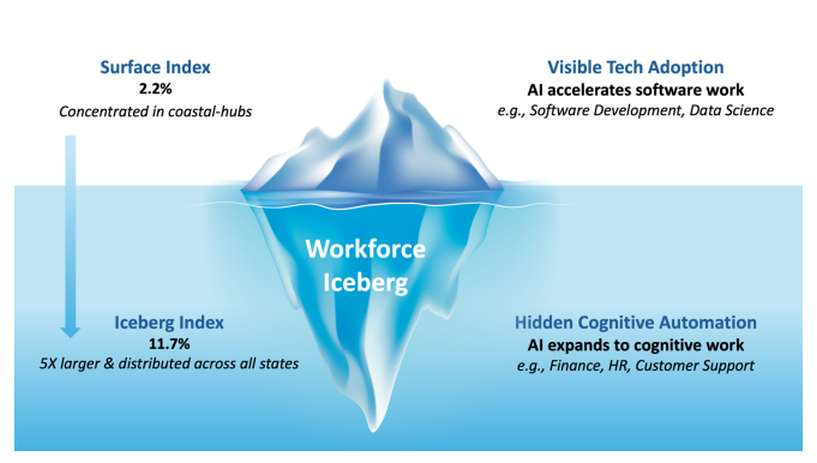
The adoption of artificial intelligence (AI) in computing and technology, which is widely known, impacts about two percent of the wage value in the US, about $211 billion. This represents only the tip of the iceberg, according to a study published last week by researchers at the Massachusetts Institute of Technology and Oak Ridge National Laboratory (ORNL). This is because, below the surface, automation will impact administrative, financial, and professional services, which is twelve percent of the wage value, about $1.2 trillion, the study states.
The study, which measures the impact of AI in reshaping America’s $9.4 trillion labor market, uses a tool known as the Iceberg Index. It measures the wage value of skills which AI systems can perform within each occupation.
The index enables the creation of “a digital twin for the U.S. labor market,” Prasanna Balaprakash, a director at ORNL and co-leader of the research, told CNBC. ORNL is a US Government research center based in Tennessee.
The Iceberg Index is a skills-centered metric which captures which occupational tasks can be performed by AI, within each county. It does not predict job displacement outcomes or AI adoption timelines.
The MIT study challenges a common assumption that AI will impact jobs only in major US urban areas, along the East and West coasts, where technology and technology-related businesses mainly operate.
When AI transforms quality control tasks in automotive plants, for instance, consequences spread through logistics networks, supply chains, and local service economies. Yet, traditional workforce metrics cannot capture these ripple effects: they measure employment outcomes after disruption occurs, not where AI capabilities overlap with human skills before AI is adopted.
In contrast, the Iceberg Index’s simulations show occupations which are at risk of being displaced by AI across all 50 states, including inland and rural regions. The simulations represent 151 million workers in 3,000 US counties as autonomous agents, doing 923 jobs and more than 32,000 skills, while working with more than 13,000 AI tools.
The project has drawn the interest of some US senators, law makers in Tennessee, North Carolina and other states and members of the national AI task force.
The Iceberg’s insights are powered by Large Population Models which simulate the human-AI labor market, states Ayush Chopra in a LinkedIn post. He is the lead author of the MIT report, co-leader of the study and a PhD student at MIT. The computing platform used for the MIT study is a Frontier supercomputer at ORNL, which powers many large-scale modeling efforts.
AI is transforming work, notes the MIT report. “We have spent years making AIs smart—they can read, write, compose songs, shop for us. But what happens when they interact? When millions of smart AIs work together, intelligence emerges not from individual agents but from the protocols that coordinate them. Project Iceberg explores this new frontier: how AI agents coordinate with each other and humans at scale.”
“Iceberg simulates an Agentic US—a human-AI workforce where (more than 151 million) human workers coordinate with thousands of AI agents - recreating the scale of US workforce. We run this sandbox at ORNL to achieve three key objectives: We design protocols for AI teams to coordinate with each other on specific jobs. We simulate ripple effects of AI capabilities across thousands of jobs and skills in the economy. We measure exposure to the human workforce and infrastructure.”
Prasanna Balaprakash, Director of AI programs at Oak Ridge National Laboratory, oversees over ten projects involving more than 50 researchers. Earlier, he worked at the Argonne National Laboratory, 2014-2023, in Illinois, including as Research and Development Group Leader. He joined the laboratory as an assistant computer scientist, having worked there as a post-doctoral fellow, 2010;2013. He was the Chief Technology Officer at Mentis SA in Brussels, Belgium, 2009-2010.
Balaprakash, 46-years-old, is the author of twelve research papers. He earned a PhD, 2010, and Master of Advanced Studies, 2005, in Computer Science both from Université Libre de Bruxelles, Belgium. He earned a M.S. in Computer Science from Otto von Guericke - Universität Magdeburg, Germany, 2004, and B.Engg. from Periyar University, India, 2002.
Since 2022, Ayush Chopra has been pursuing a PhD at the MIT Media Lab supervised by Ramesh Raskar. His research on Large Population Models covers multi-agent AI, decentralized computation, and machine learning and has been deployed across several countries.
Earlier, Chopra, 30-years-old, was on the technical staff at Adobe, 2018-2020. He was an instructor and mentor at Coding Blocks, 2017-2018.
He has published over 50 papers and contributed to 25 patents. He earned an MS from MIT, 2020-2022, and a B.Tech. in Computer Science from the Delhi College of Engineering, 2014-2018. He attended the Delhi Public School, Rohini, 2000-2014.
For now, Iceberg is not as a finished product but a sandbox, or tool, which states can use to study and prepare for AI’s impact on their workforces. “Project Iceberg enables policymakers and business leaders to identify exposure hotspots, prioritize training and infrastructure investments, and test interventions before committing billions to implementation,” the MIT report says.
North Carolina state Senator DeAndrea Salvador has worked with the researchers of the MIT study. She told CNBC, the simulations enable lawmakers to identify which local jobs and skills are likely to be “automated or augmented (by AI), and what could that mean in terms of the shifts in the state’s GDP in that area, but also in employment.”
LISTEN TO PODCASTS ON YOUTUBE OF SOME PAST GLOBAL INDIAN TIMES STORIES: CLICK ON THIS LINK.