
Can Monica Sunny’s Chai Box Grow into a Major Tea Brand
Monica Sunny’s Chai Box sells organic teas, blended with spices from Kerala, to consumers in the United States

By Ignatius Chithelen.
June 26, 2026
Earlier this month, the first Chai Box Café opened in Atlanta, United States. “It’s finally Chai time!” posted founder Monica Sunny on Instagram, where she has over 55,000 followers. “The Chai Box began as a family recipe and a dream of sharing Chai with others…that dream becomes Atlanta’s first Chai Cafe!”
The café sells hot teas, including a masala tea, All Chai’d Up, for $5 and an Iced masala tea for $6. It also sells an Iced Matcha, made from ground green tea leaves, for $7, and coffees, in partnership with Driftaway Roasters.
Chai Box and other high-priced tea and coffee vendors benefit from a market developed by Starbucks. Over the past four decades, Starbucks has expanded to more than 40,000 stores globally, with nearly half of them in the United States. Consumers shifted to buying Starbucks coffee, abandoning local vendors and powders and beans sold by Folgers, Nestle’s Nescafe, and other giant brands. In 2025, Starbucks, which has a market value of $115 billion, had $37 billion in revenues.
Many consumers, having been introduced to a better coffee by Starbucks, seek fresher brews for their daily caffeine kick. Meanwhile, numerous physical and online stores sell tea, tea leaves, coffee and coffee beans, which they say are superior tasting, heathier, and environmentally friendly.
The vendors range from cafes run by Chai Box and local baristas to chains of stores. One of the chains is Blue Bottle Coffee, founded in 2002 by James Freeman, a freelance clarinet-player in Oakland, California. He had grown weary of the commercial coffee enterprise and stale, overly roasted beans. Blue Bottle operates more than 100 stores in the US and another 40 in Japan, South Korea and China. Then, there is Nestle’s Nespresso which operates 802 stores in 515 cities, in 81 countries.
Chai Box’s online store sells a range of items including several varieties of loose-leaf teas and blends of teas mixed with spices; also concentrates, gift sets, spices, spoons, tumblers, mugs, candles, tote-bags, and stickers. The spices are sourced “from small-scale farmers in Kerala who…have been cultivating their spices for generations,” according to a Chai Box post on LinkedIn. The family of Sundeep Sunny, Monica Sunny’s husband, is from Kerala.
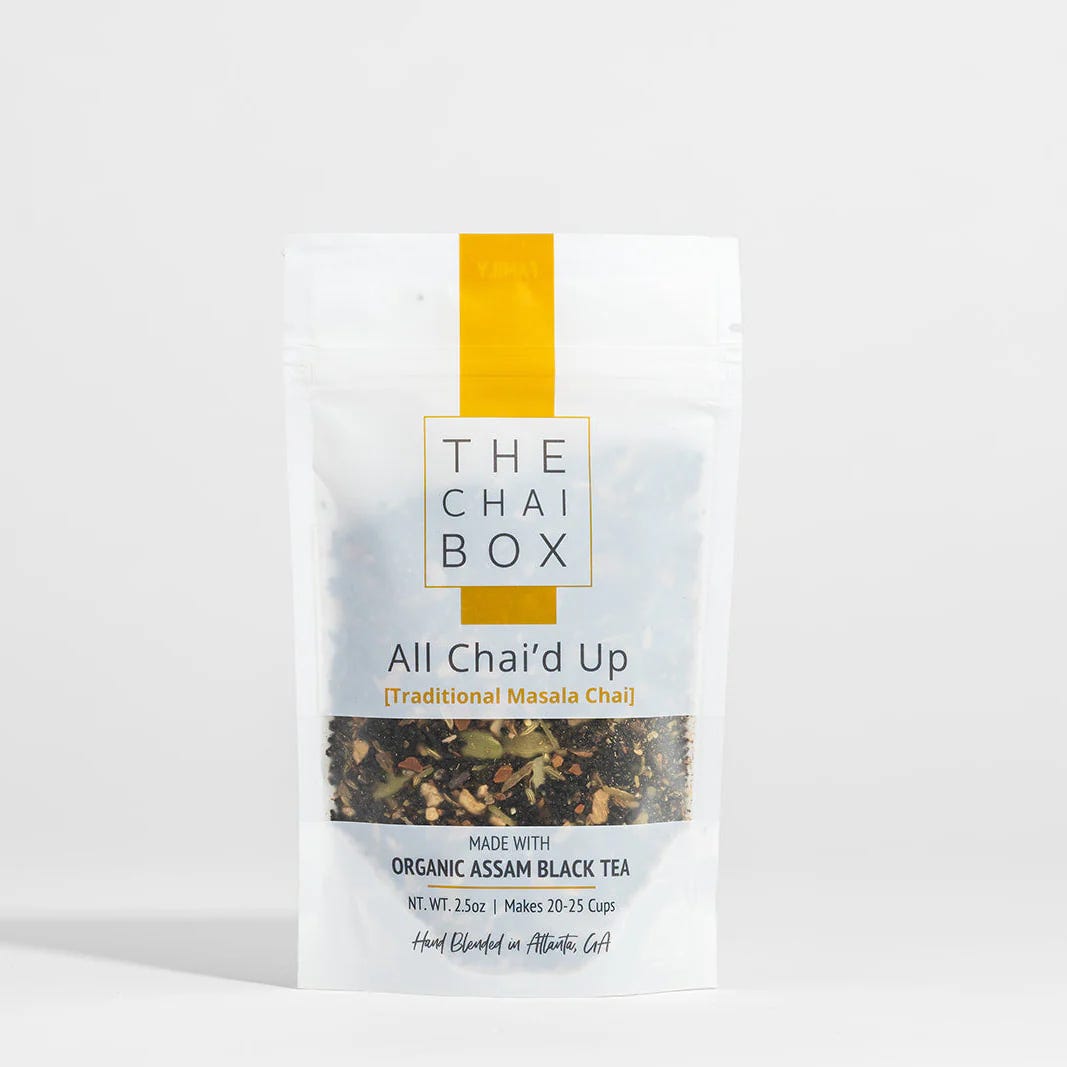
All Chai’d Up, Chai Box’s version of the popular Indian masala chai, is a blend of loose-leaf Assam black tea with ginger, clove, cinnamon, cardamom, and fennel. A one-pound pack sells for $65, good for brewing about 90 cups of tea, based on the typical 15 oz size mugs in American kitchens. While the price is steep for a home-brewed tea, it is comparable to the prices paid by US consumers for a cup of coffee, buying Nespresso pods for their expresso machines.
“Ever since I was a little girl, Chai was an integral part of my family’s daily ritual,” notes founder Sunny on the Chai Box site. “I have taken my passion for Chai with my mother’s recipes, along with generations before, and created blends inspired by different regions in India.”
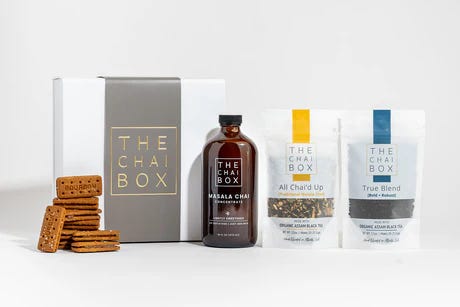
Chai Box’s teas have gotten good media coverage, including on the Food Network and epicurious. In 2021, film and TV star Oprah Winfrey chose Chai Box’s The Ultimate Chai Lover’s Gift Set as one of Oprah’s Favorite Things. Now called The Chai Lover’s Set, and priced at $80, it includes four bottles of teas: 2.5 oz of All Chai’d Up; 2.5 oz of Sweet Monsoon, a blend of black tea with flavors of mangoes, coconut, cinnamon, and clove; 2.0 oz of Hill Station, a blend of black tea, cardamom and roses; and 1.7 oz of Lavender Nights, a caffeine-free blend of lavender, rose, and cardamom, made with rooibos leaves.
Winfrey’s team also arranged for the teas to be featured on the ABC television show Good Morning America. Following the TV show and Oprah’s recommendation, Chai Box’s monthly sales quadrupled to $377,000, according to CNBC.
In 2016, Sunny launched The Chai Box online store as a side-business after a mom, enjoying the tea she offered during a play-date for one of her sons, asked why she wasn’t selling the teas she blended.
In March 2020, following the start of the COVID-19 lockdown, Monica Sunny lost her job and her husband Sundeep Sunny was furloughed from his job, according to CNBC. She focused full-time on The Chai Box, including approaching retailers, attending food industry trade shows, and adding more posts on chai meditation on her store’s Instagram app.
Sunny,worked as a human resources consultant in Atlanta, for Chick-fil-A, a chain of fast-food chicken sandwich outlets, from 2003 to 2020. Earlier, she was at Accenture, 2000 to 2003, according to her LinkedIn profile.
She earned a MS in Human & Organization Development from Vanderbilt University, 2000, and a BS in Education from Georgia State University, 1997.
Monica Sunny, 51-years-old, has three sons whom she taught to make chai at an early age. She migrated to the US in 1984, from Punjab, India, when she was nine-years-old, along with her parents. “(M)y parents were working fast food jobs just to survive,” Sunny told Oprah Daily. “So, my brother and I were always home alone cooking and cleaning…it was my first time seeing tea bags…As an immigrant family, we may not have been able to afford much, but we could always afford chai.”
“(M)y dad has been my unofficial business consultant since the start of The Chai Box (and even before). I call him every single morning to seek his advice,” Monica Sunny told Shoutout Atlanta in 2023. Chai Box has under ten employees, according to its LinkedIn site; seven others on the site were former employees.
Sundeep Sunny co-founded Chai Box with wife Monica, according to a Georgia Tech post. He manages the manufacturing, supply chain, and operations. He studied at Georgia Institute of Technology, Atlanta, also known as Georgia Tech, according to an Instagram post. Apparently, neither Chai Box nor Sundeep have published his professional and educational information.
Evidently, the Sunnys have ambitions to grow Chai Box into a major brand. As part of this effort, Chai Box’s teas are also sold at some Costco and Paper Source stores in the US. In 2024, Costco stores in Los Angeles and Southern California began carrying Chai Box’s bottle of Masala Chai Concentrate, Sweetened. The first Costco order boosted Chai Box’s revenues by a fifth, according to a Georgia Tech research note.
In 2025, Chai Box began selling its Masala Chai Concentrate in thirteen Costco stores in Georgia, North Carolina, and Alabama. A news release making this announcement stated Chai Box was “a women-owned” company. On its website too, Chai Box states it is certified as a Women Owned Business, apparently to publicize it seeks contracts set aside for women and minorities by companies and government agencies.
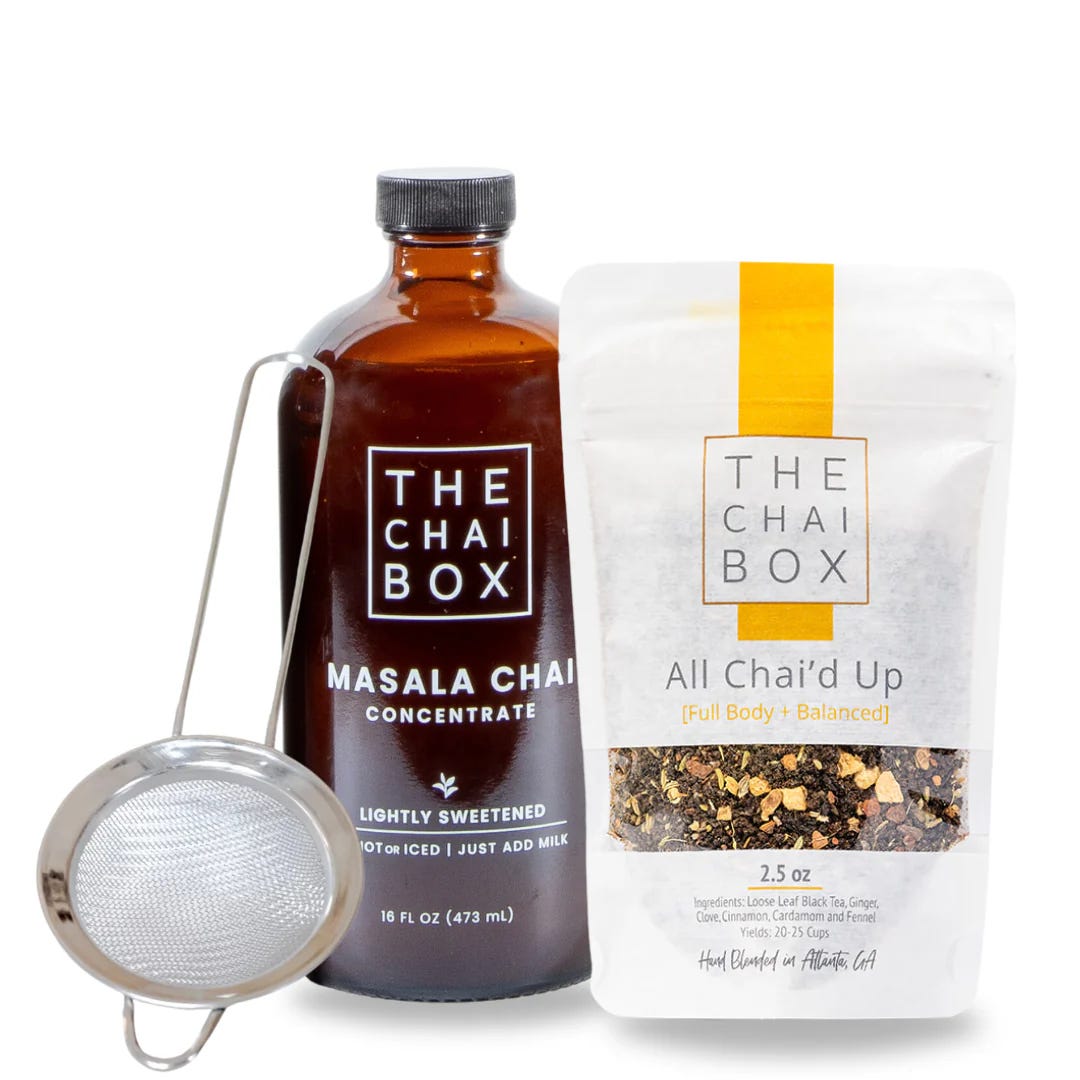
Currently, on the Costco site, a Chai + Biscuits + Stainless Steel Steeper Gift Set, from Chai Box, sells for $39.99. The set includes a 16 oz bottle of Masala Chai Concentrate, lightly sweetened; 2.5 oz of All Chai’d Up, the masala chai blend; 2.5 oz of True Blend, a traditional loose-leaf chai; one pack of Bourbon Chocolate Biscuits; and one stainless steel steeper. As usual, Costco enables its members to make the purchase at a big discount. Buying the same items online on Chai Box, a Chai+Biscuits gift set and a steeper, costs $58, nearly 50 percent more.
The other Chai Box item sold online by Costco is the Founder’s Chai Loose Leaf Collection, for $59.99., This is a one third discount from the $80 price for a similar set of six teas, Founder’s Chai Collection, on the Chai Box site.
Perhaps, Chai Box sells large volumes of products via Costco, which makes up for the lower price it receives.
However, selling even premium teas and coffees is intensely competitive, largely a commodity business, with no barriers to entry for new sellers. Costco’s site, for instance, lists more than fifteen premium, organic breakfast teas, including from large brands like Bigelow, Twinings, and Pure Leaf, all stating their teas are made from natural ingredients and are environmentally friendly.
So, to grow Chai Box into a sizeable brand, Sunny faces the challenge of fine-tuning the quality, quantity, and price of the teas to attract more new buyers and convert them into long-term customers. A big advantage in selling caffeinated teas and coffees, as Starbucks, Nespresso and Blue Bottle have shown, is that, once buyers like a taste, and are satisfied with the service and price, they will keep buying since the beverages are addictive.
Apparently, Sunny’s strategy is to first attract Indians and other South Asians in the US as customers. But South Asians are extremely price-conscious. Online, alongside the Chai Box products, Costco lists competing products, like Stash Tea Essentials Variety Pack, a box of 180 tea bags, 30 each of six flavors including masala tea, for $23.99. Costco’s own Kirkland brand 100-count green tea bags, which sell for $13.99, has gotten 1,922 five star ratings from buyers. Yet, if Sunny can attract even five-percent, of nearly two million South Asian households in the US, to buy Chai Box teas, it could be a profitable, niche company.
“Growing up in an Indian household, I started drinking Chai at the age of two and blending teas at the age of twelve,” Sunny says in a blog post. “For me, Chai is more than just a drink, it is a part of my culture and heritage...an integral part of my family’s daily ritual.”
An earlier story on The Chai Box was published April 15, 2022.
Ignatius Chithelen is the publisher of Global Indian Times and author of Six Degrees of Education and Passage from India to America. A Chartered Financial Analyst, he is manager of Banyan Tree Capital, New York. Neither he nor Banyan has any financial or other interests in any of the companies mentioned in this story.
This essay will be part of the book, Kerala and Keralites: The Promise and Challenges. The book is a collection of essays and interviews from the Global Indian Times, edited by Ignatius Chithelen and Cherian Samuel. Bryant Park Publishers. Publication date July 2026.