

February 6, 2026
In 2021, Vinod Jose, accepted the Louis M. Lyons Award for Conscience and Integrity in Journalism from Nieman Fellows at Harvard University. The award was given to The Caravan, a New Delhi-based magazine of which Jose was then Executive Editor, “in recognition of its reporting on the erosion of human rights, social justice, and democracy in India.”
Speaking at the award ceremony, Jose said, “Christians are randomly being picked up — nuns harassed…Priests and missionaries being attacked. Every religious minority” and lower castes are targeted in India.
In 2025, there were nearly 900 attacks on Christians in India, according to Christian Solidarity International, “continuing a five-year surge in attacks that intensified during the Christmas season.”
The attacks are carried out by Hindu extremists reportedly belonging to groups affiliated with the Rashtriya Swayamsevak Sangh (RSS), including the Bharatiya Janata Party (BJP) which rules India with Narendra Modi as Prime Minister. The “prime minister hasn’t said a word against the Hindu radicals who attacked Christians,” notes a columnist in The Wall Street Journal.
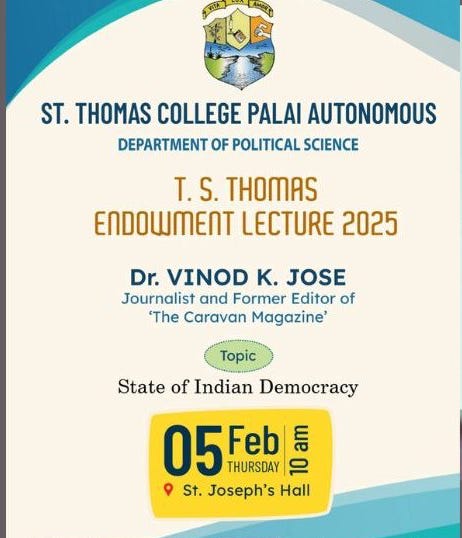
One of the attacks in 2025 was in Kerala, where a man from the RSS attacked “a group of children under 15,” damaging their musical instruments during a Christmas carol performance. So, it is odd that, this week, the St. Thomas College, run by the Catholic Church in Palai, Kerala, cancelled Jose’s lecture on the State of Indian Democracy.
“Funnily enough, with the disinvitation,” Jose notes in a social media post, “the lecture has already been delivered, without me uttering a word. The state of Indian democracy stands explained.” Jose learnt about the cancellation, for being a “controversial figure,” from a fellow speaker and not from the college management.
Vinod K Jose was the Executive Editor of The Caravan, New Delhi, from 2009 to 2023. Under him, the magazine exposed numerous corruption scandals in India; many involving governments of BJP’s Narendra Modi as well as former Congress Party Prime Minister Manmohan Singh.
“The Caravan has persistently spoken truth to power while documenting the rise of political Hinduism in the country over the past decade,” the Nieman Fellows noted. “Risking violence and imprisonment, its reporters have written an essential series of investigations into Hindu supremacist terrorism, political murder, caste and gender injustice, and ethnic violence against India’s Muslim minority. The Caravan has repeatedly demonstrated that it represents a beacon of moral clarity in Indian public life.”
In 2021, there were ten judicial cases outstanding against Jose and the publisher of Caravan, in five states where the administration and “the police report directly to Prime Minister Modi,” Jose said while speaking at Harvard. The magazine also faced multi-million-dollar legal threats from a major company with close ties to the government. He added, “A small publication like us will be worried whether we will be run out of business, whether they will send us to jail.”
At Caravan, Jose noted, the journalists were extremely lucky to have an owner who gave “us a lot of freedom,” despite financial, legal and other threats, unlike at most major media companies in India. Also, the magazine has a large, growing number of subscribers which provides financial independence and stability.
Caravan was founded in 1939 by Vishwa Nath, inspired by Mahatma Gandhi who was then leading India’s struggle for freedom from British rule. Now it is published by the Delhi Press Group, run by Nath’s grandson Anant Nath. The group publishes 33 magazines in English and nine Indian languages.
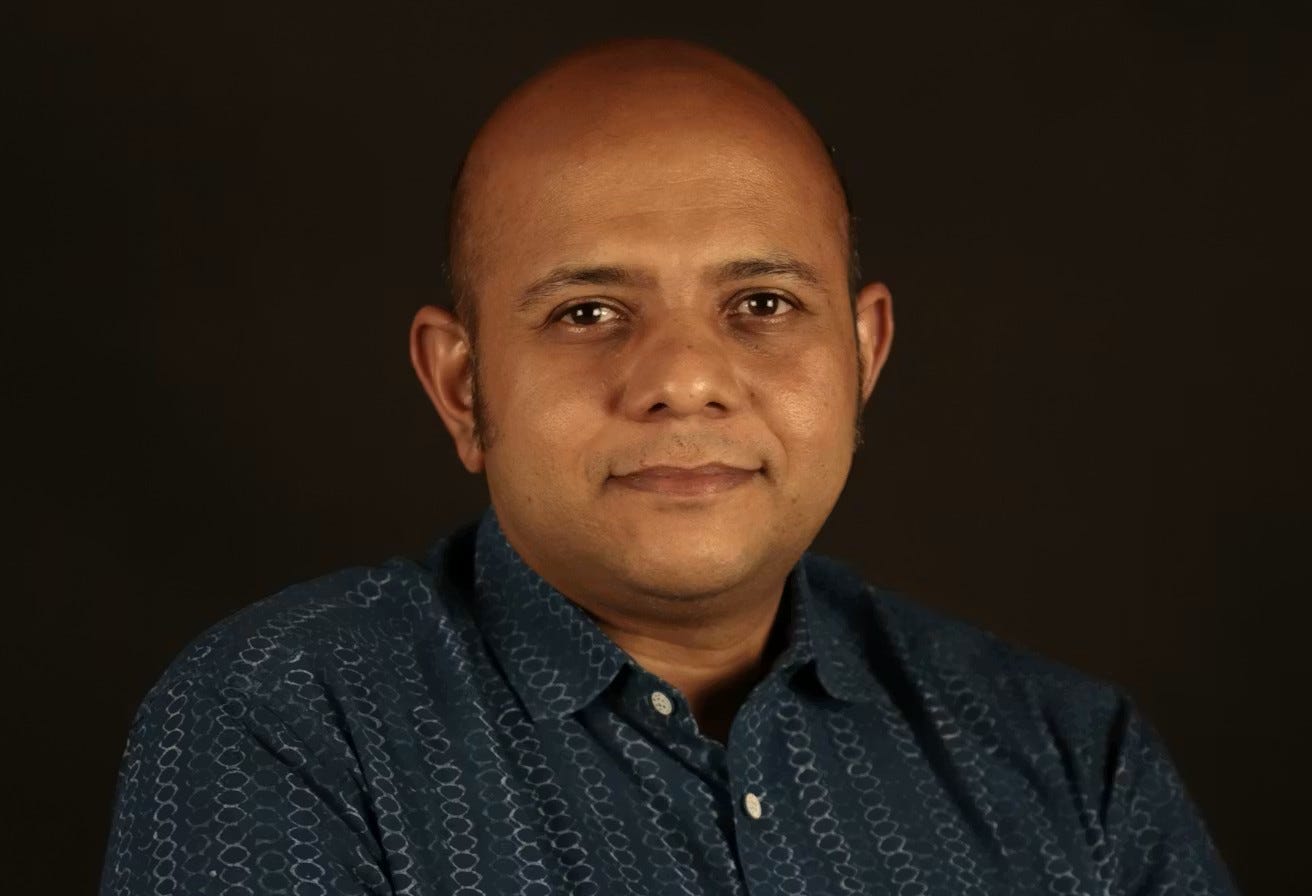
(Photo: Vinod Jose, courtesy Wayanad Literary Festival.)
In 2008, Jose worked as a producer in South Asia for Pacifica Radio. From 2002 to 2007, he was a freelance radio producer, including for BBC and NPR. He started his career as a reporter for The Indian Express, Delhi, in 2001. From 1997 to 2001, while a student, as a freelancer, he reported stories for Udayavani, a Kannada publication, and wrote features for Malayalam newspapers Mathrubhumi and Malayala Manorama.
Vinod Kizhakkeparambil Joseph, 46-years-old, is the director of the Wayanad Literary Festival, Kerala; it is next scheduled to be held in December 2026. He was a Radcliffe Fellow at Harvard University School of Advanced Study, 2021-2022. Jose earned a PhD in sociology from Jamia Millia Islamia, Delhi, 2011; an MS from the School of Journalism, Columbia University, New York, 2008; an MS in communications from Manipal University, India, 2001; and a BA in English from Mary Matha Arts & Science College, Wayanad, Kerala, 2000. He grew up in Wayanad.
Part of the mission of St. Thomas College is “To empower the students with deep knowledge and awareness of current developments in their chosen subject of study.” The college, which was founded in 1950, offers 18 undergraduate and 15 postgraduate programs and ten research departments. It has nearly 2,900 students and 151 faculty members. Alumni include K. G. Balakrishnan, former Chief Justice of India, Tom Jose, the current Chief Secretary of Kerala, and Siby George, India’s former ambassador to Switzerland, Vatican and Liechtenstein. Past speakers at the college include Nobel Laureates Ada E. Yonath, chemistry, 2009, and Klaus von Klitzing, physics, 1985.
Given accomplished alumni and past speakers, the college management’s decision to cancel Jose’s lecture, which was presumably backed by officials of the Catholic Church, will hurt the college’s reputation. Sibi James, head of St. Thomas College, did not respond to questions from The Wire. Sources familiar with the management told the publication that Jose’s lecture could have resulted in Modi’s Government blocking the college from receiving foreign donations.
In his post, Jose implies that his lecture may have been cancelled because, “If not all, at least a section of the Christian society in Kerala are tiptoeing the RSS-BJP line of blocking relevant, transparent conversations at the least, and at its maximum, working to help the Hindu right get a foothold in Kerala.”
Story updated February 7, 2026