
Coconut Harvest in Kerala Shrinks as Real Estate Demand Rises
Policies to stem the decline in Kerala’s coconut output may not work says Sunil Mani

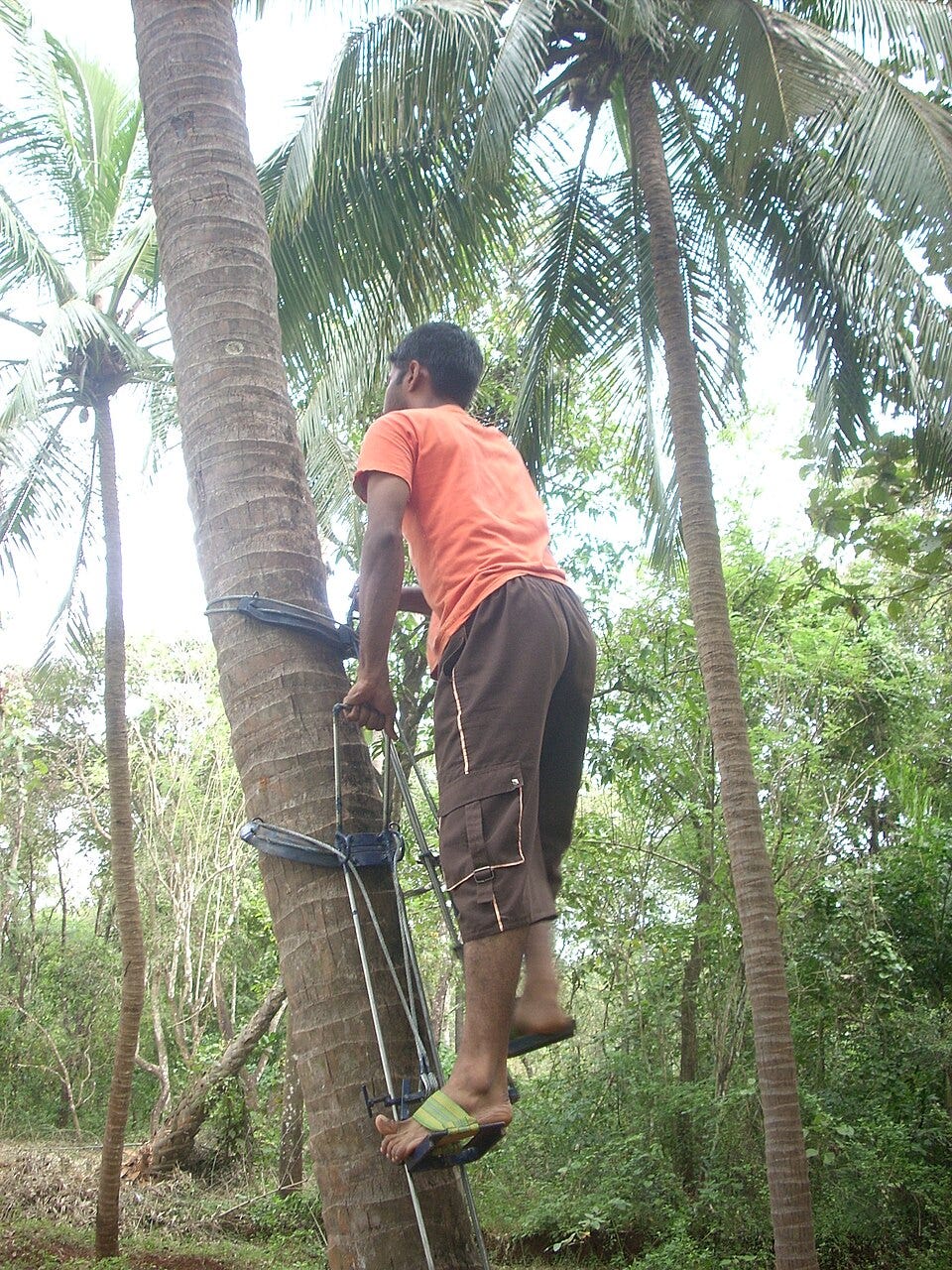
(Photo: A coconut tree climber in Kerala. Courtesy Wikipedia.)
By Sunil Mani
April 3, 2026
Over the past twenty-five years, the total area of coconut farms in Kerala has shrunk by roughly a quarter, according to the state’s Planning Board. In 2024–25, coconut cultivation covered nearly 770,000 hectares. These farms still account for nearly a third of the state’s total cropped area. So, by far, coconut continues to be Kerala’s biggest farmed crop and a key part of its economy. Rubber is the state’s second largest crop covering about a fifth of the farmed area.
Coconut products are a key ingredient in a Keralite’s daily food consumption, from breakfast and meals to snacks. The fruit is also used to produce a wide range of processed products. Oil, which is extracted from copra, dried coconut kernel, is the major processed product. Major oil brands operating in the state include Marico’s Parachute and local vendors like Kerafed and Mezhukkattil Mills. Other kernel-based products include desiccated coconut, coconut milk and cream. Also, virgin coconut oil which is made by cold-processing fresh kernel.
The water from tender coconuts is a popular natural health beverage all over India. The coconut shell is a raw material used for producing activated carbon, which is a value-added export. Then, coir and coir pith, derived from the husk, are inputs for the state’s coir industry.
The total annual value of Kerala’s coconut economy is estimated to be more than Rs 35,000 crores, US $3.8 billion. Coconut oil and kernel products account for more than half, coir and coir products for about a fifth, and virgin oil, activated carbon and other products account for the rest.
The coconut economy in Kerala, including cultivation, harvesting, processing, and marketing, is estimated to employ more than 3.5 million, making it the largest single employer in the state. Nearly a quarter of them are employed in coir-related jobs.
The decline in area under coconut cultivation in Kerala is mainly due to the conversion of farms into real estate development, homes and apartment and commercial buildings. Some of the development is carried out by the landowners themselves, especially those who have the funds to invest.
Demand for real estate continues to be strong due to rising household incomes, especially for families with sons and daughters working abroad, mainly in the Persian Gulf countries. Another factor fuelling demand is the state’s rising population, currently around 35 million.
Over the past two decades, land prices in Kerala have seen a sharp increase driven in large part by strong demand from Keralites, especially emigrant sons and daughters working in the Persian Gulf countries. According to Kerala government data, land prices in the state have more than doubled since 2010, with prices rising far higher in Kochi, Thiruvananthapuram, and other urban areas. Contrary to official data, land prices in the state have likely risen by more than four times in the past 25 years according to real estate investors and brokers.
Under current farming practices, the net returns, after all costs, from coconut cultivation in Kerala range from about Rupees 30,000, US $300, to Rupees 70,000, US $720, per hectare annually. So, a household growing coconuts, even in a remote rural region of Kerala, can earn eight times more per year by selling the land and investing the proceeds in a safe, fixed income deposit with a government-run bank, than from selling coconuts. The only thing holding back more growers from selling land is a farming family’s age-old eagerness to hold onto their land. Also, some of them are holding on hoping to sell when prices rise even higher.

(Photo: A coconut grove in Kerala. Courtesy Wikipedia Commons.)
For centuries, coconut farming has played a key role in Kerala’s economy. The coconut palm, Cocos nucifera, is deeply intertwined with everyday life, serving as a culinary staple, a source of livelihood, and a cornerstone of cultural identity. In fact, the very name Keralam is derived from the Malayalam word kera, meaning coconut tree, signifying that the region is the “land of coconut trees.”
The decline in Kerala’s annual coconut output is sharper than the decline in coconut farming area. In 2024–25, roughly 5.6 billion coconuts were harvested in the state, down by half over the past decade, according to the Coconut Board. With rising harvests in others states, Kerala’s share of India’s coconut production has fallen to about two-fifths, down from two thirds in the early 1970s. Since 2022, Kerala is estimated to be the third largest coconut producer, trailing the neighboring states of Karnataka and Tamil Nadu.
The sharper decline in output per hectare, for coconut farms in Kerala, is due to a drop in productivity. In 2024–25, coconut farms in the state harvested roughly 7,211 nuts per hectare, more than a fifth below the all-India average of 9871 nuts.
A major reason for the lower productivity is that coconut cultivation in Kerala has largely become a homestead-based activity, characterised by scattered trees. Unlike in other states, many growers in Kerala have not adopted advanced yield-enhancing practices. The practices include integrated drip irrigation and fertilization, high-density planting and monocropping, use of hybrid/dwarf varieties, integrated nutrient and pest management, and mechanised harvesting tools which enhance the capabilities of tree climbers.
Also, Kerala faces an acute shortage of coconut tree climbers which has reduced routine maintenance, such as crown cleaning and early disease detection as well as harvesting efficiency. Overall, a shortage of labor in the state has led to higher wages for climbers and other laborers, which reduces a grower’s income.
Another factor reducing coconut farm yields in Kerala is the shorter, more intense rainfall, rising temperatures, and heat stress. Such climate changes have made the trees more vulnerable to pests and diseases like root wilt and the red palm weevil.
Not surprisingly, the decline in coconut production in Kerala has led to a spike in prices, raising the cost of food. Since 2019, the retail price of a coconut has more than doubled to Rupees 70, US 80 cents. Coconut oil prices have soared with premium brands selling for as high as Rupees 770, US $8, per litre.
Since the mid-2010’s, with sliding harvests and rising consumption, Kerala has been a net buyer of coconuts from other states. Major oil mills in Kerala are buying from growers in other states, mainly neighboring Tamil Nadu where growers offer lower prices, than in Kerala, to bulk buyers. In the past, traders in Kerala bought coconuts from local farmers, turned them into copra and then sold the copra to mills for oil extraction.
Even while retail prices have risen, there is a large gap between what coconut growers in Kerala earn and what consumers pay. In February 2026, price data shows that growers received about half the retail price: farm‑gate prices were about Rs 26, US $0.24, per kilogram of copra in Kerala compared with an average retail price of around Rs 59, US $0.60). Both farm‑gate and retail prices fluctuate widely with changes in supply and demand.
Most growers in Kerala sell raw coconuts and not copra and other value-added products. In an effort to help raise a grower’s income, Keralaagro shops, set up by the Kerala government, buys coconuts - and other produce- from farmers. The produce is sold directly to consumers, cutting off the profits pocketed by traders and other intermediaries. However, the government-run stores have minimal impact since there are only about 30 outlets, selling well under one percent of the state’s coconut output. Keralaagro hence appears to be more of a model to demonstrate the potential of raising farm incomes, by bypassing traders, rather than a state-wide solution to raise farm incomes.
Roughly two thirds of Kerala’s coconut harvest is processed into copra and oil, with nearly all of the value-added tasks being done by traders and oil mill owners. Kerafed, the Government of Kerala’s coconut cooperative, procures, processes and distributes coconuts, copra and coconut oil. But this mainly benefits traders and mill-owners. Kerafed wholesales the oil and copra to distributors and retailers, who reach about 14,000 retail stores across Kerala. Keraafed competes with Keraagro since both of them buy coconuts from farmers. However, Kerafed is a much larger operation.
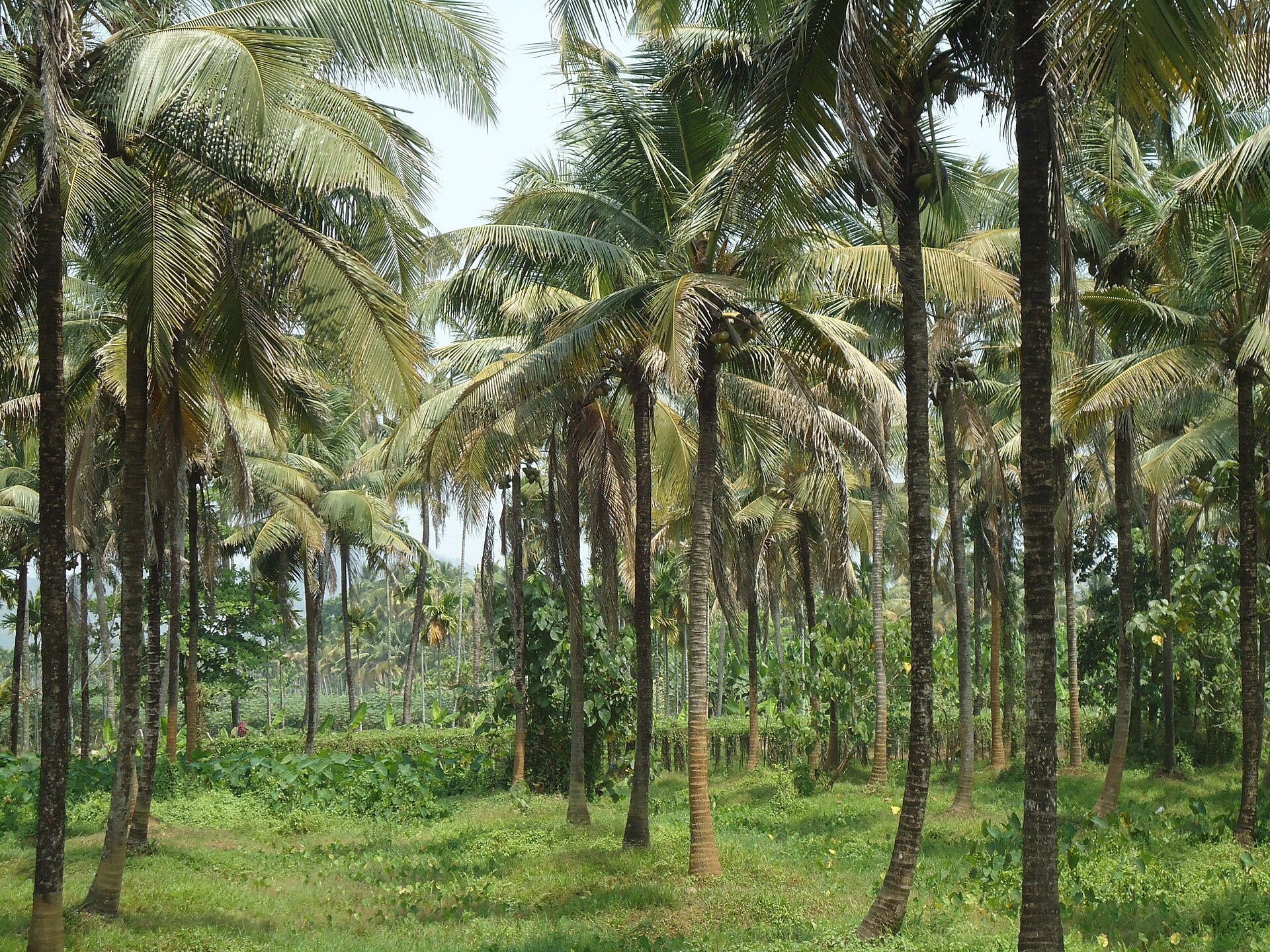
(Photo: A coconut farm in Kerala. Courtesy Wikipedia Commons.)
In 2025, to try and tackle the decline in farming area and productivity, Kerala’s Coconut Board introduced several measures. The grant for a new planting was raised sharply from Rupees 6,500, US $68, per hectare to Rupees 56,000, US $590. The board is also promoting multi-cropping, growing coconuts with banana, pineapple, cocoa, pepper and grass, to boost a grower’s income. It is also funding entrepreneurs to set up startup business to process coconuts into value-added products.
Between 2020 and 2025, Kerala’s Agriculture Department distributed more than 5.6 million coconut seedlings to growers, mostly at subsidized prices. They included both dwarf and tall, hybrid trees. Roughly three quarters of the seedlings were planted.
The dwarf trees will begin bearing fruit in about four years, while the tall varieties will take around seven years. By 2030, if a substantial share of the new plantings survive to maturity, annual coconut output in Kerala could rise by several hundred million nuts.
Even while the coconut farming area in Kerala shrinks, incomes of the remaining farming households can be raised by shifting from homestead cultivation to commercial cropping on larger size farms. One way to do this is to raise the limits on land ownership. This is highly unlikely since distribution of farmland, to laborers and small farmers who farm crops, has been the focus of major political struggles in the state for more than a century.
Another option is for households in Kerala to farm coconuts collectively via co-operatives. Yet, while there are several hundred co-operatives in the state, they operate as purchasing and marketing groups, not as entities collectively farming land. Or, households should be allowed to lease farm their land to growers who want to cultivate a larger area. Leasing of farm land is legally permitted, with regulations, in several Indian states, including Andhra Pradesh, Tamil Nadu and Maharashtra. Kerala is among the states which imposes restrictions or bans on leasing farm land.
The Kerala government could try to curtail land sales for real estate development by taxing purchases at very high rates. But this will anger emigrant workers who eagerly look forward to a retired life in a home they own in Kerala. The emigrant Keralites account for a major share of the consumption spending in the state.
As land prices keep rising, more households will likely sell their coconut farms, including some with newly planted seedlings.
Sunil Mani is a visiting professor, Centre for Development Studies, and Ahmedabad University, both in India. The views expressed are personal.