
Are India's IPL Cricket Teams at Peak Valuations
Sharp rises in media rights fees have boosted valuations of Indian Premier League cricket teams says Cherian Samuel

April 24, 2026
By Cherian Samuel
In March, a group of American investors agreed to pay Rupees 153 billion, US $1.6 billion, for the Rajasthan Royals, according to ESPNcricinfo. The Royals are a men’s cricket team in the Indian Premier League based in Jaipur, Rajasthan.
When the sale closes, the original owners of the Royals, which is a group led by Manoj Badale, will apparently earn a 2,400% gain on their purchase of the team in 2008. Such a 19% compound annual return, over the past eighteen years, beats the investment gains of most stock, private equity and venture funds in the United States and the United Kingdom.
The Indian league is a cricket contest, in the Twenty20 format, among ten teams based in major Indian cities. Two teams play a single innings each, limited to a maximum of twenty overs, 120 legal deliveries. The owners of the Royals also own similarly branded cricket teams, the Paarl Royals in the South African League and the Barbados Royals in the Caribbean Premier League.
According to ESPN, other current owners of the Royals include Lachlan Murdoch, chief executive of New York based media company Fox Corporation, and Red Bird Capital, New York, which manages $14 billion, including investments in sports teams.
The buyers of the Royals is a group reportedly led by Kal Somani, an existing investor in the franchise. Based in Scottsdale, Arizona, he is the founder of IntraEdge, an outsourcing company, and co-owner of Academian, an education technology services company. The other buyers are Rob Walton, an heir to the Walmart fortune and part of the group which owns the National Football League’s (NFL’s) Denver Broncos team, and Michael Hamp, son of Sheila Ford Hamp, member of the Ford Motor Company family which owns the NFL’s Detroit Lions team.
Also, in March, a group of Indian and American buyers agreed to pay Rupees 166 billion, US $1.8 billion, for the Royal Challengers Bengaluru cricket franchise. The Challengers’ men’s and women’s teams won their respective league titles in 2025.
The buyers are led by the Aditya Birla Group, an Indian family which runs aluminum, cement and other companies in forty countries, with a total market value of more than $100 billion. The other buyers are the Times of India Group, Bolt Ventures, and Blackstone. The share of ownership among the partners is not disclosed.
Blackstone is a New York based firm managing $1.3 trillion in assets, ranging from equities, bonds, real estate, private equity, and sports teams. It has a market value of $89 billion. Bolt ventures, the private investment platform of David Blitzer, owns other sports properties including the Crystal Palace Football Club in the UK Premier League and the Philadelphia 76ers in the US National Basketball Association league. Blitzer is the Chairman of Blackstone’s Tactical Opportunities Group and earlier led the firm’s European private equity business. He joined Blackstone in 1991 and has a net worth of $4 billion, according to Forbes.
The Challengers is being sold by an Indian-subsidiary of Diageo, the London-based vendor of Johnnie Walker whiskey and other alcoholic drinks. The sale of the cricket franchise is expected to close after it receives legal, regulatory and other approvals.
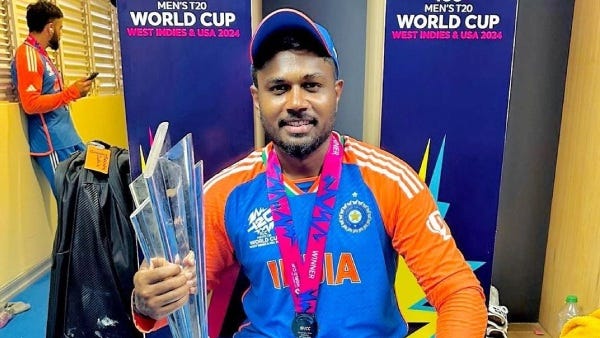
(Photo: Sanju Samson, with the 2026 T-20 Cricket World Cup. Samson is a member of the Chennai Super Kings IPL team. Courtesy: ICC.)
In 2025, revenues from sports in India totaled Rupees 189 billion, US $2 billion. according to a WPP Media report. Cricket accounted for an estimated nine tenths of the revenues. Men’s cricket has always been a big business in India. In fact, it continues to be the only major sports business in India, boosted by the Indian Premier League. The league was launched in 2008 by the Board of Control for Cricket in India. The Board sought to copy the financial success of the T20 Blast, now known as the Vitality Blast, which was launched in the UK in 2003.
The Indian league gives Indians, who are huge cricket fans, an added jolt of entertainment: ten teams playing 84 matches over two months, from March to May. The Twenty20 games are fast paced three-to-four-hour contests, featuring the top Indian and foreign cricketers.
The teams pay large sums to hire the best talent from major cricket playing nations. Among the foreigners playing in the current 2026 season are Australian Cameron Green. The Kolkata Knight Riders are paying him a record Rupees 250 million, US $2.6 million, according to the BBC. Other foreign players include Heinrich Klaasen from South Africa, Jos Buttler, England, Matheesha Pathirana, Sri Lanka, Mustafizur Rahman, Bangladesh, and Sherfane Rutherford, West Indies.
Among the highest paid Indian players are Virat Kohli, who earns Rupees 210 million, playing for the Bengaluru Challengers; Sanju Samson, who earns Rupees 180 million, US $1.9 million, playing for the Chennai Super Kings; and Kartik Sharma and Prashant Veer, who both earn around Rupees 160 million, US $1.7 million. In March, Samson’s batting was key to India winning the 2026 T20 World Cup.
The Indian league teams are also sprinkled with aging, former Indian superstars like Mahendra Dhoni, 44. They are there more to attract cricket fans dripping in nostalgia. The games are also spiced with cheerleaders, music, and fireworks.
The league’s season attracts more than a billion viewers on TV and online platforms, the most watched cricket league in the world. They include more than 400 million unique TV viewers, according to CVC, which is part owner of the Gujarat Titans league team. Given such a massive, growing audience, most of the league’s revenues comes from fees for the global TV broadcast and digital media rights.
The current five-year media rights deal for the Indian league, valid from 2023 to 2027, brings in more than Rupees 484 billion, US $6.2 billion, or more than US $1.2 billion per year, according to sportspro.com. The Indian cricket board retains half of this revenue while the league teams share 45%, according to IPL.com. The teams also earn revenue from local sponsors and sales of tickets, jerseys and other merchandise.
The current media rights were bought, following an auction in 2022, by a group comprising Star India, Viacom18, and Times Internet. The price they paid was reportedly more than double what Star India paid for the 2018 to 2022 media rights, Rupees 165 billion, US $2.6 billion, according to sportspro.com. Star India was then part of the US media giant Walt Disney.
Times Internet is part of the Mumbai based Times of India Group. The group owns Willow which broadcasts all major cricket matches, including the Indian league, in the U.S. Willow charges a US $9.99 monthly subscription; it also offers a US $79.99 annual plan.
In November 2024, Star India merged with Viacom18 to form JioStar. While Disney owns 37%, JioStar is controlled by Reliance Industries. Reliance is India’s largest private company, with fiscal year 2026 revenues of US $124 billion, operating in a range of businesses including energy, petro-chemicals and media. Mukesh Ambani is Chairman of Reliance while his wife Nita Ambani is Chairperson of JioStar.
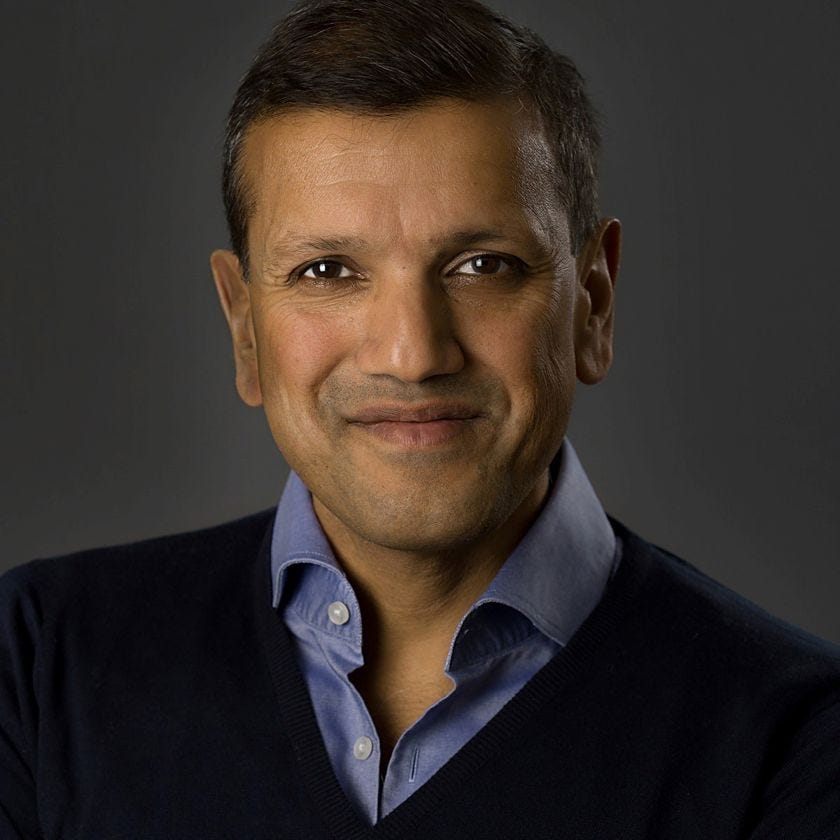
(Photo: Manoj Badale, former lead-owner of Rajasthan Royals. Courtesy British Asian Trust.)
The annual fees for the Indian cricket league’s media rights have reportedly risen twelve-fold since the first season. Japan’s Sony bought the TV rights for the first ten IPL seasons, 2008 to 2017, for a total $1 billion, $100 million a year, according to ESPNcricinfo.
The sharp rise in media fees have boosted the valuations of Indian league teams, both the resale price of existing teams and the prices paid at auctions for new franchisees. In 2021, nine bidders reportedly took part in an auction held in Dubai by the cricket board for new Indian league teams. The RP Sanjiv Goenka Group, an Indian business family, won the bid for the Lucknow Super Giants for a price of Rupees 71 billion, US $964 million, according to ESPN. CVC Partners won the bid for the Gujarat Titans, based in Ahmedabad, for reportedly Rupees 56 billion, US $750 million. CVC, based in Luxembourg, is a global investor, including in private equity, credit and sports teams, with Euro 205 billion in assets under management.
In 2008, the cricket board reportedly secured $724 million when it auctioned the eight initial franchisees. The original teams were the Mumbai Indians, Kolkata Knight Riders, Royal Challengers Bangalore, Chennai Super Kings, Rajasthan Royals, Delhi Daredevils, now Delhi Capitals, Kings XI Punjab, now Punjab Kings, and Deccan Chargers. In 2013, the Chargers were replaced by Sunrisers Hyderabad.
The initial owners were wealthy Indian business families, Indian companies, and Bollywood stars. The Mumbai Indians, for instance, is owned by a subsidiary of Mumbai-based Reliance Industries. It is controlled by Mukesh Ambani, who has a net worth of $92 billion, according to Forbes. Reliance also owns JioStar, which is the major current owner of the Indian league’s media rights. The Chennai Super Kings is owned by a subsidiary of India Cements, whose chairman is N. Srinivasan, a former president of the cricket board. The Kolkata Knight Riders is owned by Bollywood superstar Shah Rukh Khan, and actress Juhi Chawla and her husband Jay Mehta, of the Mehta Group.
Following the success of the UK and Indian Twenty20 leagues, similar leagues have been launched in other countries: the Big Bash League, Australia, 2011; Bangladesh Premier League, 2012; Caribbean Premier League, West Indies, 2013; and the Pakistan Super League, 2016. Given the size of India’s population, and its fervent cricket fans, the Indian league has the biggest audience and is the richest league.
In recent years, similar to the Rajasthan Royals, Indian league franchise owners have bought teams in other national leagues. For instance, the owner of the Mumbai Indians team also owns the New York team in the US league, the Cape Town team in South Africa, and the Emirates team. The Chennai Super Kings owns Joburg Super Kings, in South Africa, and Texas Super Kings in the US. And the Kolkata Knight Riders owns the LA Knight Riders, US, and Abu Dhabi Knight Riders.
A group of investors led by Manoj Badale owns 65% of the Royals franchise, according to msn.com. In the 2008 auction, Badale’s group reportedly paid $67 million, the lowest price among the eight initial franchises. This was possibly because there were few competing bidders for the team since it is based in Jaipur. It is a far smaller city compared to Mumbai or Bengaluru, whose franchises were originally bought for around $111 million each, according to msn.com.
The sale of the Royals, when completed, may be one of Badale’s major investment successes. He is a British-Indian co-founder of more than 15 businesses, largely technology-related, since 1998. Badale, 58-years-old, and Charles Mindenhall co-founded London-based Blenheim Chalcot, a digital venture investor. In 2011, Blenheim bought Home Learning College, the UK’s largest online vocational learning provider.
Badale is the co-founder of netdecisions group, a major internet services provider, which is now Agilisys, an information technology services and outsourcing business based in Alpharetta, a suburb of Atlanta, US. Earlier, Badale was a partner at Monitor Company, working in the UK, Germany and India. He earned an MA in economics from Emmanuel College, Cambridge University. Badale, who was born in Dhule, Maharashtra, India, grew up in the UK.
In a 2023 interview with the Business of Sport, Badale said that the financial success of the Royals was due to the management’s long-term strategy based on collecting and analyzing data, ranging from trends in performance of batters and bowlers to size of audiences. This enabled the Royals to run a lean operation, with tight cost controls, and hire, at a cheap price, less-known cricketers with the potential to perform well in the twenty overs league match format.
Most Indian cricket pundits predict valuations of Indian league teams will keep rising, with some forecasting they will exceed $5 billion by 2035. In contrast, a report from D&P Advisory, a valuation consultancy based in Bengaluru, says the Indian men’s league is “grappling with maturity and recalibration.” This is in part because the consolidation of TV platforms in India “has transformed the media rights ecosystem, altering the balance of competition and value creation.”
Is there any significance, for the future valuation of Indian league cricket teams, when an investor like Manoj Badale, with a good track record, is selling his stake in the Rajasthan Royals?
(Story updated April 25, 2026.)
Cherian Samuel, a writer based in Washington DC, retired from the World Bank. He earned a PhD in Economics from the University of Maryland.