

By Sunil Mani
August 21, 2026
In fiscal year 2025-2026, 23 billion payment transactions, totalling Rs 314 trillion, US $3 trillion, occured via Google Pay and other apps, between consumers and businesses, businesses and businesses, and government agencies and citizens in India. In June 2026, 555 million Indians were linked to such payment apps.
When a consumer in India buys a toothpaste on Flipkart, or sweets at a local store, or bananas from a street vendor, or pays for an Uber ride, she pays by scanning a QR code, sent by the vendor, via her Google Pay App on her cell phone. To protect themselves, consumers are expected to use a security PIN.
The vendor receives immediate confirmation from their bank that the payment was received, assuming there are enough funds in the customer’s bank account which is linked to her App. Once approved by the sender’s bank, the funds move directly to the recipient’s bank account.
Google Pay, PhonePe and other apps also enable consumers to receive electronic payments from employers, banks, and government programs. These platforms replace similar transactions made in the past using cash and checks.
All payments and withdrawals by a consumer or business, through an electronic payment app, are processed through the bank accounts to which the app is linked. As of March 2026, 703 banks were live on the platform, including the State Bank of India and other major government-owned banks.
The underlying system, which enables the electronic transactions, was set up and is maintained by the Unified Payments Interface (UPI). It does not charge Google Pay and other payment apps for using its infrastructure. The payments apps also do not charge a fee to either the sender or recipient in a transaction.
There is an effort by the government to charge merchants a fee, ranging from 0.25 to 0.5 per cent of the electronic transaction amount. But this may not happen since the proposal faces major opposition from merchants, whose lobbies have considerable influence with Prime Minister Narendra Modi’s Government.
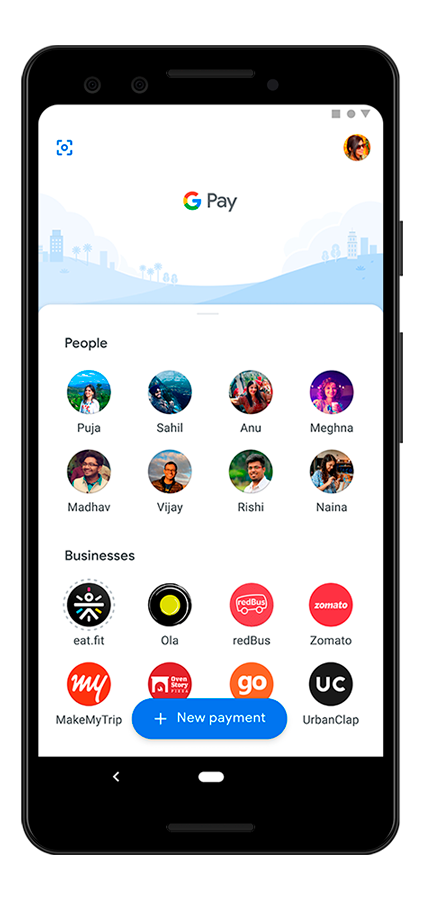
Google Pay and the other apps earn revenues by selling a wide range of products and services to users, including advertising, travel bookings, bill-payments, consumer and business loans, insurance and investment products. Some of these products and services are offered by the payment apps in collaboration with the banks, which are linked to a user’s accounts. In such cases, the apps and the banks share the fees earned. Given these varied revenue sources for the apps, they apparently offer free access to electronic payments more to retain and attract new users.
As of June 2026, PhonePe and Google Pay together accounted for approximately four-fifths of all consumer-based electronic payment transactions. PhonePe was the largest, followed by Google Pay. PhonePe is majority-owned by Walmart, the US retailer with a market value of $922 billion. Google Pay is part of Alphabet, also a US company, with a market value of $4.2 trillion.
Users of the apps need to have a bank account to which it is linked. The banks do not charge a fee for the electronic transactions. They also waive their typical requirements that consumers hold a minimum amount of funds at the bank, or pay fees, to hold an account. Banks though earn interest on the funds held by app users at the banks and sell bill-payments, loans, credit cards and other services to the consumers.
In 2016, the Unified Payments Interface (UPI) became operational. The government’s main goal was for the electronic payments infrastructure to reduce the costs of fund payments and receipts while enabling hundreds of millions of unbanked Indians to use bank accounts. That year, the government demonetized the Rs 500 and Rs 1,000 notes which gave the nascent digital payments an additional push. Competition among the apps was a big reason for the wide adoption of electronic payments.
UPI is operated by the National Payments Corporation of India, a not-for-profit company. It was set up by the Reserve Bank of India, India’s central bank, and the Indian Banks’ Association, which represents both government-run and privately owned banks.
The initial total cost of developing and setting up the system, and the contributions of the government and other entities have not been publicly disclosed. The government has subsequently provided major financial support to sustain and promote the system, including an estimated Rs 10 billion in 2021–22 and Rs 30 billion in 2023–24.
PhonePe, Google Pay, and the banks invested funds to create and connect their services as well as for marketing to attract users. The amounts they spent is also not publicly disclosed.
In 2016, the Government of India also launched a payment app BHIM (Bharat Interface for Money), as a potential rival to Google Pay and the other privately-owned apps. BHIM though failed to gain major consumer adoption. Recently the government has been advertising BHIM, seeking to expand its user base.
Regulations of the Reserve Bank of India, India’s central bank, seek to provide protections for consumers, including full transparency and disclosure of bank charges. Yet, there is a wide range of prices charged for the same services by different banks. Also, the minimum-balance requirements, charges and fees for various differ widely from bank to bank.
Past studies by the Reserve Bank, and its ombudsman data, reveal complaints about banks charging consumers high, and often hidden, fees. So, it appears possible that, while the basic electronic payment service is free, consumers pay other costs to maintain and use the bank accounts needed for their electronic transactions.
Similarly, there are numerous micro-level studies on electronic payment systems which expose leakage–theft–of funds from a consumer’s account, ghost beneficiaries, officials demanding bribes, and payments sought by banks for access.
One study found that use of biometric smartcards substantially improved the efficiency and accountability of India’s welfare system by reducing payment delays, leakage and transaction costs. However, the technology did not eliminate corruption since some local officials figured out how to use it to collect bribes from card users. The study, by Muralidharan, K Niehaus, P and Sukhtankar, S, was published in the American Economic Review, 2016.
The Reserve Bank does not separately report the amounts of fraudulent transactions which occur on the electronic payments platform. Apparently, this data is included in the credit card, internet or digital-payment fraud category. In 2024-25, banks and consumers reported more than 13,000 cases of fraud, totaling Rs 5.2 billion. Apparently, the Reserve Bank does not conduct its own studies to determine the level of such fraud.
In the case of electronic payments, the incidence of fraud, and the total amounts stolen from consumers, may be very high. This is partly because of low-levels of numerate skills among most Indians. While India’s official illiteracy rate is 20%, independent studies suggest it is far higher.
Even so, assume that half a billion Indians, who use the electronic payment system, have good literacy skills. Also, assume that users find it easy to read the payment apps since they are in the major Indian languages. Yet, even most college graduates make errors while trying to track fund receipts and payments and figuring out fees, while examining a bank account statement in a printed form.
Tracking payment transactions in an online account is even tougher, especially for most Indians who only have mobile phones. The screens on mobile phones are, at best, six inches diagonal in size. This is the size, for instance, of Vivo, the most popular mobile phone in India. Also, the records are dense with data, since consumers conduct dozens of transactions each week. So, it is difficult for even college graduates to track and verify that payments were sent to the right vendor and that all payments that were due were received in full.
Anecdotal evidence suggests that “helpers” — posing as bank officials, agents, social workers, local leaders, and vendors – easily gain access to a consumer’s account, via their mobile phones, and steal funds.
There is hence an urgent need for an annual study to examine consumer losses, arising from fraud and other risks, especially for the elderly and those who have not completed secondary education. The study should also identify the true, total costs for a consumer to use the electronic payments system. Such studies should be both easy to conduct and accurate since the data is electronic, offering all the details of every transaction. The studies, perhaps funded by the Reserve Bank, ought to be done by a reputed, independent research institution.
Until such studies provide insights on consumer losses and costs, there will be legitimate doubts when Indian officials claim that the country’s rapidly expanding digital-payment system is a major success.
Sunil Mani is a visiting professor, Centre for Development Studies, and Ahmedabad University, both in India. The views expressed are personal.