
Will Taaleem’s Harrow Schools in the UAE Compete with Sunny Varkey's Premium GEMS Schools
GEMS Education, founded by Sunny Varkey, operates a wide range of for-profit schools in the Gulf countries


(Photo: Harrow International School, Dubai. Courtesy Taaleem Holdings)
By Ignatius Chithelen*
June 6, 2026
In August, the Harrow International School for boys and girls, set up by Taaleem Holdings, will begin operating in Dubai. The school will combine “Harrow’s 450-year tradition of academic excellence with Taaleem’s proven dedication to delivering the highest standards of education” across the United Arab Emirates, the school’s site states. The private, for-profit school is based on the British curriculum. Located on a twelve-acre campus, facilities include digital design and 3-D printing spaces, orchestras, cricket nets and a rugby and soccer field.
The original Harrow, set up in 1572 under a British Royal Charter, is a non-profit, residential, upper school for boys. Located on a 224-acre campus near London, it has roughly 830 students. Alumni include British Prime Minister Winston Churchill, India’s first Prime Minister Jawaharlal Nehru, King Hussein of Jordan, scientists, inventors, writers, admirals, and businessmen.
The academic leaders of Harrow Dubai Harrow are British, who bring “a deep understanding of the British independent school system,” according to the school’s site. The total annual fees at Harrow Dubai range from AED 86,650, US $23,400, for nursery, to AED 119,440, $32,200, for the upper school. The fees at the Harrow School in Britain totals nearly $90,000.
The Dubai school is the first of the Harrow schools which Taaleem plans to launch in the UAE, Saudi Arabia, Bahrain, Oman, Qatar and Kuwait, which together make up the Gulf Cooperation Council. The schools will be independently owned and operated by Dubai-based Taaleem. Harrow’s teams oversee that the “educational purpose, practice, strategy and philosophy, tailored to the needs of their students and locations,” meet Harrow’s standards.
In 2025, Dubai-based for-profit GEMS Education opened its School of Research and Innovation in the city. Based on the British curriculum, its programs include training in digital skills, ballet, fencing, and martial arts. The fees, which range from $25,000 to $35,000, are similar to those of Harrow Dubai.
The UAE comprises of seven kingdoms. More than three quarters of its eleven million population live in Abu Dhabi and Dubai, which each have roughly four million people. Abu Dhabi’s revenues come from exporting roughly three million barrels of crude oil per day. Dubai has two major ports, a major cargo airport and is a tourism hub.
Nearly ninety percent of UAE’s population are expatriate blue and white-collar workers, with about half from India and the rest from Pakistan, Bangladesh, and Philippines. British and Americans occupy many of the senior roles in business and government-run entities.
Roughly two thirds of the students in the Gulf countries are enrolled in free, government-run, primarily Arabic language schools. The region has very few quality, non-profit international schools. So, for-profit schools are the only option for expat and Arab parents, who have the income and want their children to study at an international school.
In Abu Dhabi and Dubai there are roughly 260 international schools operated by GEMS, Taaleem, Aldar Education, Nord Anglia, and other companies. They offer the International Baccalaureate, British, American, French, Indian and Egyptian curriculum.
Parents pay high fees at some of the for-profit schools, like Harrow Dubai and GEMS Innovation, expecting their children will be admitted by a top international college. Hence, it is not surprising, that, while Harrow Dubai says it will teach students the Harrow values of “Courage, Honour, Humility and Fellowship,” its major goal is to prepare students “for entry into leading universities worldwide.”
Top colleges admitting students from existing Taaleem schools include Cambridge and Oxford in the UK, and the University of California, Berkeley, and Johns Hopkins in the US. “GEMS students today are graduates of leading universities around the world,” states Sunny Varkey, in a founder’s message on the company’s site. Varkey, 69-years-old, is founder of the Dubai-based Varkey Group, which reportedly also owns healthcare, hotels and other business.
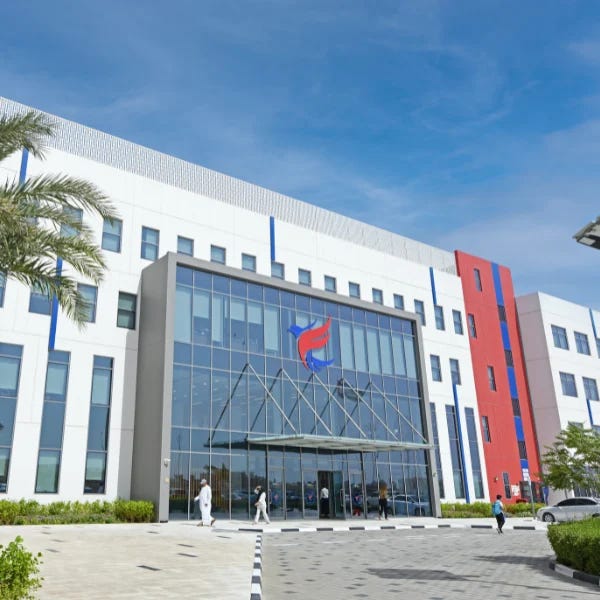
(Photo: GEMS International School, Dubai. Courtesy GEMS.)
Taaleem, which means education in Arabic, owns and operates 13 premium schools in the UAE - ten of them in Dubai - with nearly 19,000 students. It also operates 23 schools on behalf of UAE government entities, with 24,000 Emirati students. Taaleem’s Chairman is Khalid Al Tayer, an Emirati. He is the managing director of a division of the Tayer Group, which owns nearly 200 retail stores in the Middle East, including joint ventures with Gucci, Prada, Armani, and other luxury brands.
Aldar manages 31 schools, mostly in Abu Dhabi, with 33,000 students. It owns some of the schools. Founded in 2007, it is part of Aldar Properties, a major developer and manager of retail, residential and commercial real estate. Listed on the Abu Dhabi Securities Exchange, Aldar Properties has a market value of roughly $16 billion, according to Reuters.
Sahar Cooper, the Chief Executive of Aldar Education, previously served as the Chief Schools Operations Officer at GEMS Education. Ravi Ramani, Aldar’s head of finance and information technology, was earlier “a key member of the leadership team” at GEMS for sixteen years.
GEMS operates 49 schools, with full or partial ownership, in the UAE, Qatar and Egypt. It also manages schools in other countries, including four in India, with one in Kochi, Kerala. GEMS serves more than 200,000 students and employs over 18,000 teachers and staff. The Chief Executive is Dino Varkey and Deputy CEO is Jay Varkey, sons of Sunny Varkey.
The GEMS schools in the UAE and Qatar have varying facilities and charge a wide range of fees. For instance, at the GEMS Dubai American Academy, which offers both the American and International Baccalaureate curriculum, fees range from $17,900 to $25,200. At the GEMS Our Own Indian School, Dubai, based on the Indian curriculum, fees range from $1,950 to $4,000.
Some expat and Arab parents in the Gulf, who have the financial resources, send their children to Harrow and other residential non-profit schools, run by philanthropic foundations and Christian churches, in the UK, Western Europe, US, and India. In these countries, there are also several free, high quality, government-run schools, especially in upper income localities.
For the past several decades, the top students from such reputed non-profit and government-run schools have been admitted by the best colleges in the West. Many alumni enroll their children at the top schools they attended, expecting they will then be admitted by a top college. So, they track the number of students from their schools admitted by the top colleges. Since they donate to their college, or know major donors, they lobby college officials to admit the same or larger number of students from their schools.
Given such long-established, recruiting of students from the top non-profit and government-run schools, by the top colleges, for-profit schools find it very tough to place their graduates at these colleges. So, typically, college-educated, upper income parents in the West and in India, do not enroll their children in for-profit schools, even those with brand names and modern facilities.
In 2025, GEMS “closed” its GEMS World Academy in Chicago, reportedly due to being unable to attract enough students. Started in 2013, its facilities included a planetarium, media center, a 25-meter swimming pool, and a 500-seat auditorium.
In 2023, GEMS World Academy, Switzerland, “was declared bankrupt”, according to executives-edge.com. The school shut down four years earlier. GEMS exited the Singapore, Malaysia and Kenya markets after a few years. “I should have done more acquisitions rather than doing greenfield ventures,” Varkey told Forbes in 2025.
Varkey is chairman of GEMS Schools Management which, for a fee, provides “seasoned leaders and data-led systems” to boost the “commercial success” of owners of new and existing schools.
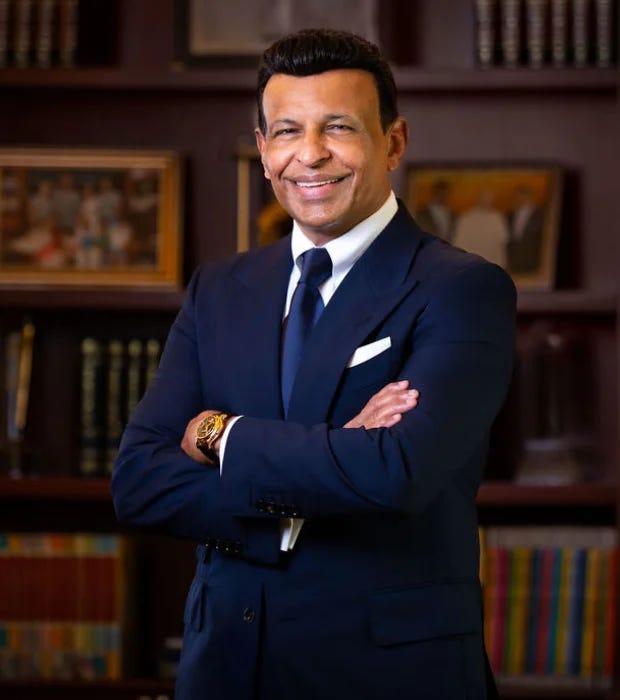
(Photo: Sunny Varkey, founder GEMS Education. Courtesy GEMS.)
Meanwhile, in the Gulf countries, for-profit schools are forecast to see rising demand. By 2029, the region may require an additional 2,800 schools, since student population is estimated to rise by one million to 15.5 million, according to Alpen Capital. The assumption is that the region’s economy continues to grow, bringing in more expat workers and their families. In three years, the Gulf’s overall population is expected to rise by about six million to 67 million.
In 2024, GEMS Education was bought by a group led by Brookfield Asset Management. This underscores Brookfield’s “commitment to investing” in the high-growth Middle East region, a news release from the company stated. It added that Brookfield “purchased GEMS Education…with its founder representing $2.0 billion in equity.” It is not known if this means the share of ownership of the Varkey Group, which founded GEMS, was worth $2 billion in the new GEMS. Based in New York, Brookfield manages more than $1 trillion in assets across infrastructure, energy, private equity, real estate and credit.
GEMS origins are traced to Mariamma and K.S. Varkey, parents of Sunny Varkey, who were expats in Dubai from Kerala, India. In 1959, they began coaching Arabs in English for a fee. In 1968, the couple set up Our Own English High School, Dubai, catering to the immigrant Indian community. The school is still in operation.
Sunny Varkey was born in Pathanamthitta district, Kerala, India. After finishing high school in India and the U.K., he did not attend college. He worked at Standard Chartered Bank in Dubai. In 1978, not wanting to retire as a bank manager with little wealth, he quit and started the Chicago Maintenance Company to perform various maintenance services. He used the title Chicago, he told Gulf News, because the western name “would make it easier to attract European expats” as clients.
In the early 1980’s, Varkey began managing his parents’ school after they promised not to interfere with how he ran it. He grew the business into the GEMS (Global Education Management Systems) network of schools.
In 2010, Knowledge@Wharton asked Sunny Varkey about the controversy over whether education should be for-profit or non-profit. Varkey said, “GEMS Education believes in education for profit because it enables us to reinvest in education and help establish more schools for more children.”
Forbes estimates Sunny Varkey’s net worth to be $4 billion. Varkey is one of the few Indian billionaires, around the globe, to sign the Giving Pledge, which requires making a public commitment to donate to philanthropies. The pledge was established in 2010 by Warren Buffett, who ran Berkshire Hathaway, and Bill Gates, co-founder of Microsoft. The London-based Varkey Foundation annually awards $1 million to a teacher.
Running for-profit schools in the Gulf countries is a lucrative business with high profit margins. In fiscal year 2025, for instance, Taaleem had a 15% profit margin; profits were $44 million on revenues of $307 million, which were both roughly double that in fiscal year 2022. Taaleem, which is listed on the Dubai Stock Exchange, has a market value of around $810 million, according to Reuters. It has 4,100 employees.
Taaleem pays a licensing fee for its Harrow schools to a subsidiary of the charity which owns Harrow School, UK. The fee is used for a number of charitable aims, including widening access to the Harrow School, UK. There are more than a dozen licensed Harrow schools operating around the World, including ten in China and one in Bangalore, India.
In about eighteen months, Taaleem plans to add 5,000 seats, boosting the 24,000 capacity of its premium schools by a fifth, including by opening its second Harrow School in Abu Dhabi. The media in the Gulf countries and education consultants label the Taaleem Harrow schools as being “super-premium.”
Apparently, Taaleem expects its Harrow brand of schools will enhance the reputation of its other premium schools, thereby attracting more students. The average annual fees at Taaleem’s non-Harrow premium schools are $16,500. So, rival schools, operating in the same markets and charging roughly similar fees, will likely face stronger competition from Taaleem.
Taaleem’s Harrow Abu Dhabi was to “open its doors to students in mid-2026,” as the first of the Harrow schools in the Gulf countries, according to a 2025 statement by the Abu Dhabi Investment Office, Taaleem’s partner on the project. It will be a residential and day school for boys and girls, based on the British curriculum. While Harrow Dubai starts operating in August 2026, Harrow Abu Dhabi does not have a website yet.
In 2025, construction of Harrow Abu Dhabi began on Saadiyat Island, according to a statement by Koda, the architectural and design firm. One of Aldar’s flagship schools, Cranleigh Abu Dhabi, operates on the same island. Based on the British curriculum, it was launched in 2014, following a “commercial agreement” with the Cranleigh School, UK. The annual fees at Cranleigh Abu Dhabi range from $19,000 to $28,500, similar to those of Harrow Dubai.
This raises a speculative question: Are there issues between Abu Dhabi’s Aldar and Dubai’s Taaleem groups, over their respective British-branded schools on Saadiyat Island, which may be delaying the launch of Harrow Abu Dhabi?
Like Harrow’s agreement with Taaleem, Cranleigh offers training and monitors the quality of the Aldar school and earns a licensing fee. A non-profit, Cranleigh also has licensing agreements with three schools in China. Founded in 1865, in Surrey, near London, the original Cranleigh is a day and residential school for boys and girls. Prominent alumni include actors, writers, rugby players and those in business. The fees for day students is $62,000 and, for residential students, $76,000.
Since February, after the start of the US-Israel war with Iran, Taaleem’s stock has fallen by a third, reflecting questions about the war’s major, long-term damage on UAE’s economy. Assuming there is little economic damage, will the rising capacity of premium schools lead to more competition between Taaleem, GEMS, Aldar, and other for-profit schools? Or, as Gulf countries rapidly expand automation and use of artificial intelligence tools, will it boost demand for highly skilled expats as well as for international schools to educate their children?
*Ignatius Chithelen is the publisher of Global Indian Times and author of Six Degrees of Education and Passage from India to America. A Chartered Financial Analyst, he is manager of Banyan Tree Capital, New York. Neither he nor Banyan has any financial or other interests in any of the companies mentioned in this story.