
Will Shamsheer Vayalil’s Burjeel Become the Leading Healthcare Company in the Middle East
Burjeel, founded by Shamsheer Vayalil, operates 115 for-profit healthcare facilities mainly in the United Arab Emirates

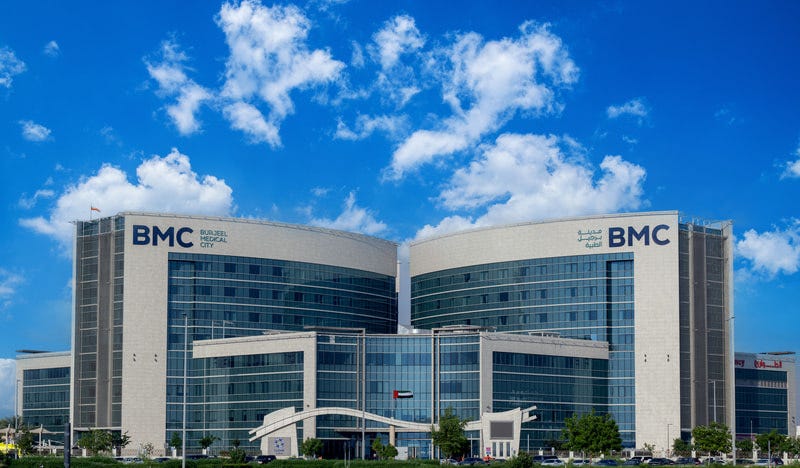
(Photo: Burjeel Medical City, Abu Dhabi. Courtesy Burjeel.)
By Ignatius Chithelen
May 29, 2026
Last month, Burjeel Holdings postponed a $1.5 billion offering of Islamic bonds, which it sought to raise to fund “an expansion of medical education and research,” according to Semafor. Investors are nervous about the economic impact of Iran’s attacks on the Gulf countries, in response to bombings by the United States and Israel. “If we get some local good government support, we might reconsider,” Burjeel Chief Executive Shamsheer Vayalil told the news site.
Burjeel, an Abu Dhabi based for-profit company, operates 115 healthcare facilities, across the United Arab Emirates, Oman, and Saudi Arabia, part of the Gulf region. They include 20 hospitals, 39 medical centers, 30 physiotherapy and wellness centers, 15 pharmacies, and 11 other allied services, including Tajmeel cosmetology and dental centers. Burjeel’s facilities, which have 1,700 beds, employ more than 11,000, including nearly 1,800 doctors.
In 2025, Burjeel’s facilities achieved - for the Middle East - breakthrough oncology procedures such as cytoreductive surgery as well as expanded minimally invasive and robotic-assisted capabilities. These advancements reinforced the company’s “position as a trusted destination for super-specialty care in the Gulf,” Vayalil, 49-years-old, said in a statement.
In the past, citizens of the Gulf countries, depending on their wealth, traveled to the U.S., Europe or India for major medical care. “What we have to build is more trust for people to believe that…(Burjeel) can offer what is available anywhere in the world,” Vayalil told CNBC in 2022. His focus is to try to “stop or reduce people traveling” abroad, from the Gulf countries, when they need medical treatment. Today, with Burjeel’s Burjeel and Medeor hospitals, and similar high-end hospitals operated by PureHealth, NMC Healthcare and other for-profit chains, far fewer citizens of the Gulf countries travel outside the region for healthcare services.
There are millions of expatriate workers in the Gulf countries, mainly from India, Pakistan, Bangladesh and Egypt. Employers are required to provide medical insurance to them. Bujeel’s LHH and Lifecare hospitals serve mid-to-low income expats. However, many of them, being low-wage, blue collar laborers, face large out-of-pocket costs and other hurdles to securing medical care. So, when they need major medical treatment, they return home.
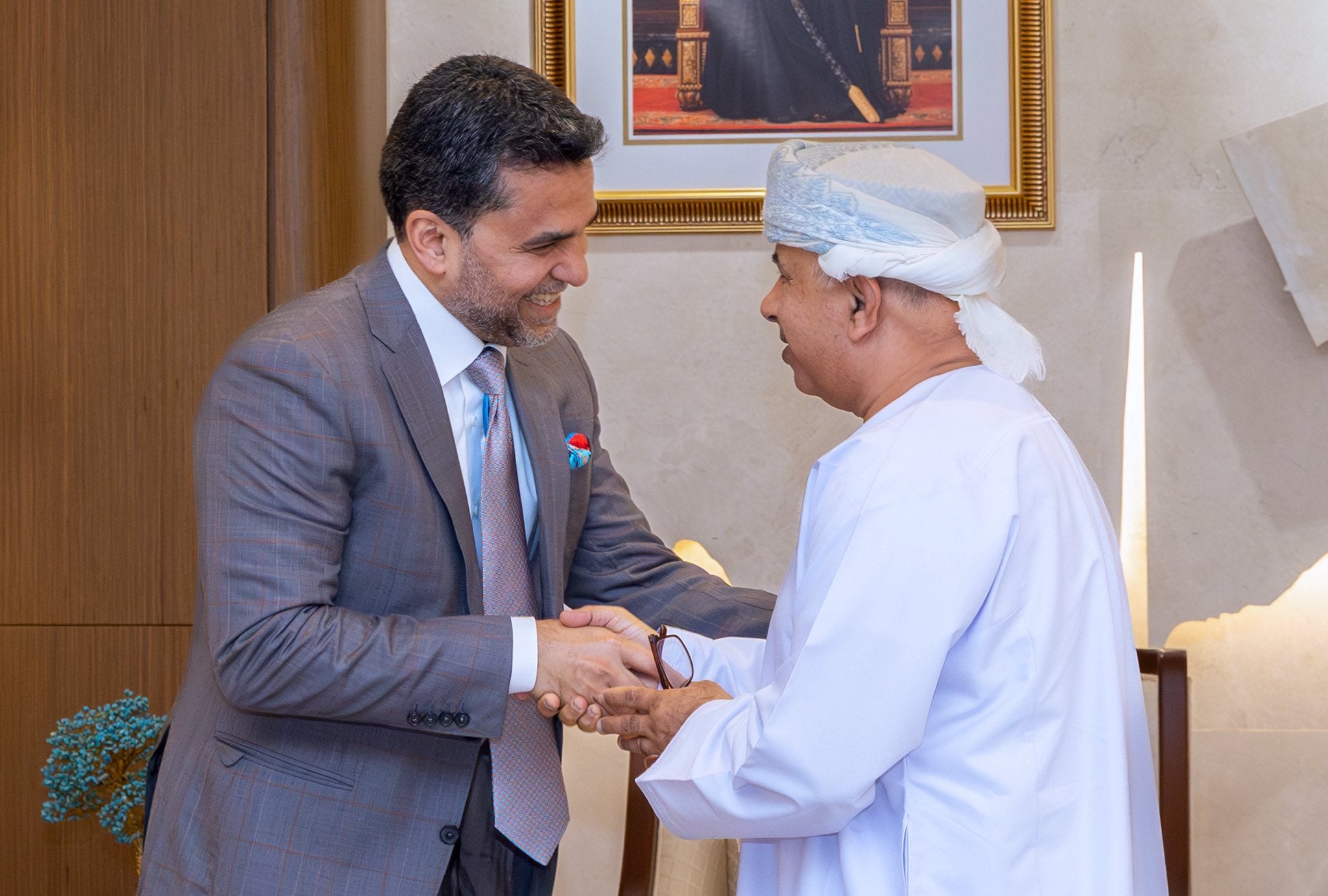
(Photo: Shamsheer Vayalil, left, with the Health Minister of Oman. May, 2026.)
In 2025, serving seven million patients and performing 89,000 surgeries, Burjeel’s net profits were US $136 million, on $1,485 million in revenues. The profit in 2025 was more than double the $63 million it earned, on $905 million in revenues, in 2021.
Hospitals account for nearly nine-tenths of Burjeel’s total revenues. However, most of the company’s out-patient and other medical facilities provide patients to the hospitals, acting as a vital feeder system. About a third of Burjeel’s revenues come from high-profit margin specialty care services, for which the fees range from AED 50,000 to AED 1 million, $14,000 to $270,000.
Nearly a quarter of Burjeel’s revenues come from its flagship Burjeel Medical City, with more than 350 beds, in Mohamed Bin Zayed City, Abu Dhabi. One of the largest private hospitals in the UAE, it handles sixty medical specialties, including centers for cancer, rehabilitation, pediatrics, and critical care.
Burjeel, which in 2022 listed on the Abu Dhabi Securities Exchange, has a stock market value of $1.5 billion. In a statement prior to the listing, Vayalil said his vision was for the company “to be the leading healthcare services provider in the Middle East and beyond.”
In 2007, at age 30, Vayalil set up LLH Hospital in Abu Dhabi, his first hospital. The previous year, he began working as a radiologist at the Sheikh Khalifa Medical City, a government-run hospital in the Kingdom, after moving there from India.
His growth strategy, Vayalil told Knowledge@Wharton in 2015, was “to go where there were no (medical) facilities available.” The goal was to build hospitals where patients go for heart surgery, knee replacement and other major issues as well as set up a network of clinics in malls where patients can go for treatment of minor ailments, monitor their diabetes and participate in wellness programs.
Vayalil earned his medical degrees in India: an MD in radiology from Shri Ramachandra Medical College, Chennai, and an MBBS from Kasturba Medical College, Manipal. They are both for-profit education institutions. The current total costs, for students from India, for the three-year MD course at Ramachandra is $101,000. The total costs for the five-and-a-half year MBBS degree at Kasturba is around $400,000. Foreign students are charged far higher fees at both places.
Shamsheer Vayalil Parambath grew up in a business family in Kozikhode, Kerala, India. His father is Hashim Pokkinari and mother Mariyam Barakkool. “My father has been a never-ending source of learning for me,” he told The International Indian. “Though a very successful businessman, he is highly devout and a firm upholder of principles and values in both his personal and professional life.”
Vayalil’s net worth is estimated to be $1.5 billion, according to Forbes. He is one of the few Indian billionaires, around the globe, to sign the Giving Pledge. Billionaires, who sign the pledge, make a public commitment to donate to philanthropies. The pledge was established in 2010 by Warren Buffett, who ran Berkshire Hathaway, and Bill Gates, co-founder of Microsoft.
“We have always believed that doing good is good business too,” Vayalil and his wife Shabeena wrote in their letter, while signing the Giving Pledge in 2018. His medical facilities have conducted 100 free heart surgeries and more than 5,000 free breast cancer screenings. In 2022, he gave a $125,000 award to the Kerala men’s soccer team for winning the Santosh Trophy, the state competition in India. He tweeted, “What a great match! Congrats, Team Kerala.” In his youth, Vayalil, who exercises regularly, represented Kerala in the inter-state table tennis competition.
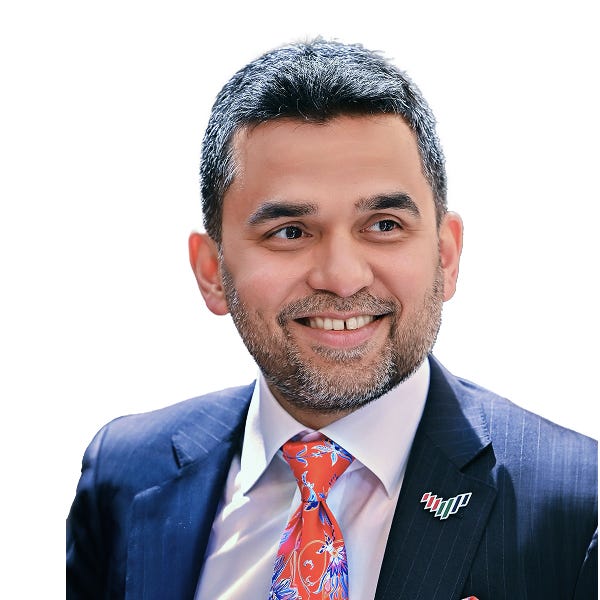
(Photo: Shamsheer Vayalil, CEO, Burjeel Holdings.)
In 2022, Burjeel was spun-off by VPS Health as a holding company for its healthcare businesses. Vayalil, who is also founder and Chairman of VPS, made the announcement at the Burjeel House in Davos, Switzerland, on the sidelines of the World Economic Forum Annual Meeting that year. In a statement Vayalil said, “Healthcare is a key focus for governments across the Middle East and we look forward to supporting our partners in the UAE…in helping build and enhance their healthcare services and infrastructure.”
Abu Dhabi-based VPS set up 20 hospitals, over 100 medical centers, pharmaceutical manufacturing and other healthcare support services in the Middle East, Europe and India. In India, its holdings included the Rockland Hospital chain in Delhi and the VPS Lakeshore Hospital in Kochi.
Vayalil’s VPS was “backed initially by his wealthy father-in-law,” retail billionaire M.A. Yusuff Ali, according to Forbes. Vayalil’s wife Shabeena is Ali’s daughter. Ali is the founder of LuLu Group International, which owns stores, shopping malls and hotels in the Middle East, India and elsewhere. A subsidiary, Lulu Retail Holdings, operates 267 stores, comprising 123 Hypermarkets, 118 Express Stores and 26 Mini Markets across six Gulf countries. It also offers online shopping via web and mobile applications as well as along with Amazon, HungerStation, Snoonu and Talabat.
Lulu Retail, which serves nearly 700,000 shoppers daily, has more than 52,000 employees. In 2025, it had revenues of $2.1 billion. Listed on the Abu Dhabi Securities Exchange, Lulu has a market value of $2.8 billion. Ali, who migrated from Kerala to Abu Dhabi in 1973, has a net worth of $5.5 billion, according to Forbes.
One of Burjeel’s competitors in the UAE and Oman is NMC Healthcare, a for-profit company based in Abu Dhabi. NMC serves more than 5.4 million patients a year, operating 70 medical facilities, including hospitals. It has a capacity of around 1,400 beds and a staff of more than 1,700 doctors, among its 12,000 employees.
NMC was founded in 1975 by Bavaguthu Raghuram Shetty, an immigrant from Udupi, India. In 2019, his net worth was estimated to be $3.2 billion, according to Forbes. He received several awards in the UAE and India. In 2005, he was reportedly the first to receive the Abu Dhabi Award, the highest civilian distinction of Abu Dhabi.
In 2020, the board of NMC discovered more than $4 billion in undisclosed debt. The company entered administration, or bankruptcy proceedings, and was delisted from the London Stock Exchange. Most of the funds were allegedly pocketed by principal shareholders and senior management. Shetty continues to face numerous lawsuits.
Bank lenders, led by Abu Dhabi Commercial Bank, which suffered big losses on their loans to NMC now own NMC. In 2024, Gulf News reported that NMC “could soon” be bought, likely by PureHealth. Based in Abu Dhabi, PureHealth operates more than 110 hospitals and 316 clinics and has a market value of $6.7 billion. It’s co-founder and CEO is Shaista Asif, who is from Pakistan.
In January this year, NMC Chief Executive David Hadley told the media, that, while talks were held with a buyer, whom he did not identify, there was no agreement. “The company will still be sold,” he stated, maybe to a private equity or sovereign wealth fund. According to The Khaleej Times, he added, “If we could consolidate with another (healthcare) group, that would be a fantastic opportunity.”
Can Vayalil seize the opportunity, given his goal for Burjeel to be the leading healthcare provider in the Middle East? He has not expressed any interest in buying NMC, at least publicly.
Even if Vayalil is interested, it may not be easy for Burjeel to raise $4 billion in debt reportedly needed to repay NMC’s bank lenders. As of March 31, 2026, Burjeel’s net debt of $760 million was higher than group equity of $600 million. Also, from its peak in 2023, Burjeel’s stock has fallen by nearly three quarters.
Burjeel is pursuing organic revenue growth, without incurring major capital expenses, by admitting more patients It seeks to do this by raising the utilization of its bed capacity, from the current 67 percent to 80 to 85 percent. Also, over the next three years, Burjeel plans to set up two new hospitals in Dubai, four out-patient surgery centers, six medical centers, and two fertility clinics in the UAE.
Earlier this month, Vayalil posted on Facebook, where he has 244,000 followers, “The encouragement and support of the UAE leadership always inspire us to think bigger, build for the future, and turn ambition into reality.”
Ignatius Chithelen is the publisher of Global Indian Times and author of Six Degrees of Education and Passage from India to America. A Chartered Financial Analyst, he is manager of Banyan Tree Capital, New York. Neither he nor Banyan has any financial or other interests in any of the companies mentioned in this story.