
An Analysis of High-Tech Industries in India
Annavajhula JC Bose reviews Sunil Mani's book which says India needs to rise from being an assembler to producer of high-technology goods

By Annavajhula J C Bose
Bose retired as a professor of economics from Shri Ram College of Commerce, Delhi*
March 7, 2026
The economic rivalry between the United States and China, and attempts by the US to reduce dependance on Chinese imports, provides opportunities for major expansion of India’s manufacturing capabilities, including in high-technology industries.
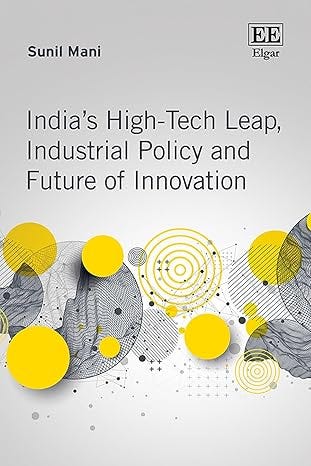
Has India been able to gain from such opportunities? This question arises upon reading India’s High-Tech Leap, Industrial Policy and Future of Innovation,** a book by Sunil Mani published in January this year. Mani reviews developments in six high technology industries in India: pharmaceuticals, computer software, vaccines for COVID-19, wind turbine manufacturing, solar photovoltaics, and electric vehicles.
While not major creators of jobs, which India acutely needs, these industries can help boost the country’s economic growth and global competitiveness and also tackle health and global warming challenges.
An economist of industrial policy and innovation in India, Mani is a Visiting Professor at the Centre for Development Studies, Kerala and Ahmedabad University, Gujarat.
Mani’s thesis is that “The path forward for India lies in adopting a more strategic, outcome-oriented industrial policy, drawing lessons from Northeast Asia while adapting them to democratic realities.” By Northeast Asia he refers to South Korea, Japan, Taiwan, and China.
He writes that India has achieved some progress in the six industries due to beneficial government policies, including on imports, subsidies and cheap funding, and collaboration between government-owned and private companies. However, barely a fraction of the full potential has been realized.
India’s pharmaceutical industry is a global leader in the production and export of generic drugs. But the companies have made little, if any, investments in research and development of new drugs, including in areas like mRNA technology, which enabled the creation of one of the vaccines to tackle the COVID-19 virus.
In the case of batteries for electric vehicles, India lacks a common standard which rival manufacturers are required to adopt so that a large, nationwide market for the crucial component can be developed. Also, in the absence of a national policy on incentives to buyers of electric vehicles, the Tamil Nadu and Gujarat state governments are offering competing incentives.
Overall, while the Government of India provides various subsidies and access to low-interest loans to the technology companies, such incentives do not require the recipients to achieve specific targets. Research tax credits given to pharmaceutical companies, for instance, are not based on outcomes like commercializing discoveries and exporting value-added drugs. In the software industry, start-ups in artificial intelligence and cloud computing receive grants without being held accountable for selling products, especially to meet rising demand in foreign markets. Electric vehicle manufacturers, which get subsidies, do not have to meet targets for promoting and nurturing the growth of a local supply chain.
Vendors of wind energy systems in India import half of all their components and nearly all of their critical parts; all their gearboxes are bought from Germany. While there is some local production of parts for solar energy systems, spurred by tariffs on certain imports, India remains dependent on China for key supplies like wafers and polysilicon. The country also imports 90 percent of the lithium-ion cells used for solar systems and electric vehicle batteries.
Effectively then, India is mainly an assembler of imported high-tech components. So, in high-tech businesses, it could be said that the Government of India is reluctant to enforce stringent local content requirements on foreign companies operating in India as well as on Indian companies importing products from abroad
Apparently, Indian government policies assume Indian companies will expand local sourcing of supplies to capture a bigger share of the profit margin. But the companies can sell products in India because they are able to secure highly coveted import licenses from the government. Hence, they are likely enjoying good profits by merely operating as importers. Why then would any such business owner risk investing funds to set up sourcing and manufacturing in India to replace imports?
Equally important, the importers appear to face little pressure from an Indian government which may be fearful of rapidly replacing imports since it could lead foreign governments to restrict buying Indian products. Also, since the Government of India faces a shortage of funds, it may have little influence over the Indian importers. If the government were to put up much of the capital, including in the form of low-interest loans, it could pressure the company owners to shift from assembling imports to locally sourcing inputs and manufacturing most of the components. It is not known if any, or some or most, of the Indian importers are getting much of their funding from the government in the form of low-interest loans, subsidies and grants. Mani ought to have explored these issues, and that too in depth, which could have provided insights on what changes are needed in policies so that high-tech industries can thrive in India.
The Indian Space Research Organisation demonstrates India’s success in a high-technology field, as Mani notes. The government-run organization offers satellite launch services to other nations while expanding use of indigenous materials, equipment and technology.
Yet, as Mani points out, unlike in the Northeast Asian economies, there is no central agency in India with a mandate to formulate and supervise implementation of policies to nurture and grow high-tech businesses, efficiently allocate capital, raw materials and other supplies, prevent wasteful competition, and most important, raise sourcing of local materials and equipment to replace imports.
To transform into a leading global high-tech manufacturer, similar to the Northeast Asian countries, India needs to build a supply chain extending from sourcing and processing raw materials to producing photo-voltaic cells, lithium-ion batteries and artificial intelligence tools. India also needs to train a workforce in the advanced skills required for such production.
*Annavajhula JC Bose and Sunil Mani were students at the Centre for Development Studies, India, in the 1980s.
** India’s High-Tech Leap, Industrial Policy and Future of Innovation, which sells for Rs.9,338, hardcover, in India, is priced way above the reach of libraries in India. In other markets, it is priced at $191.70, hardcover, and $40 eBook. The publisher is Edward Elgar, UK and USA.