
Kerala and Keralites: The Promise and Challenges. Book Launch Event.

By Cherian Samuel
August 9, 2026
Since July, twenty-six people were killed and four others are missing due to the impact of flooding across Kerala, with Kottayam, Pathanamthitta and Alappuzha districts being the worst hit. More than 27,000 are sheltering in roughly 460 relief camps. Damage from the Monsoon rains have also occurred in Assam and other Indian states.
Kerala faces repeated flood damage, which impacts lives, health, housing, farming, tourism and other areas, said Vinod Thomas. The most severe case was in 2018. Kerala should seek long-term solutions to halt climate change and minimize its damage, Thomas added. An economist and climate researcher, he was among the speakers at the virtual launch of Kerala and Keralites: The Promise and Challenges, on July 23, 2026. Thomas was answering AJC Bose’s question on how Kerala is dealing with the impacts of climate change? Bose retired from the Department of Economics, Shri Ram College of Commerce, Delhi University.
Tackling flooding and other ecological-related challenges should be one of the three key areas of focus for Kerala’s policy makers, over the next twenty-five years, said P.K. Michael Tharakan, the main speaker. Tharakan is Chair, Centre for Socio-economic and Environmental Studies, Kochi, Kerala. The discussion was moderated by Priya Menon, a Professor of English, and Director, University Honors Program, Troy University, Alabama, US.
So far, the various development programs in Kerala, including land reforms and literacy, have largely overlooked women, Tharakan added. The programs were effectively patrilineal.
While improving the overall economic opportunities and status of women, Tharakan noted policies should also offer more jobs-based skills training technical education programs as well as further decentralize administrative power and control over budget spending, building on the success of such practices during Covid-19. Olle Törnquist too emphasized the need for governance reforms in Kerala. He stated that the more democratic a state, the more developmentally inclusive it is. Törnquist is Professor Emeritus of Politics and Development, University of Oslo, Sweden.
Kerala has an estimated four million migrant laborers from Bihar, Jharkhand and other poorer regions of India. These migrants have become part of the neglected communities in Kerala, Tharakan said. While they have become an essential part of the state’s labor force, they won’t contribute to the state’s entrepreneurial development.
Migrant laborers take care of the elderly in Pathanamthitta, his home district in Kerala, said Mathew Cherian. In fact, given local labor shortages, the migrants are a key resource in addressing the labor needs and costs of tackling elder care challenges in Kerala. Cherian, Chair of CARE India, earlier served as the Chief Executive of HelpAge India.
Tourism, especially related to the traditional nature-based Ayurveda practices, offer major potential for additional job creation and economic growth in Kerala, said Sunil Mani. He added that knowledge-based industries, including medical devices manufacturing, may be a niche area that Kerala could excel in. Mani is a visiting professor, Centre for Development Studies, Kerala, and Ahmedabad University, Gujarat, India.
Kerala faces major financial challenges, especially rising budget deficits, said Vinod Thomas. Much of the state expenditures is spent on salaries and pensions, which reduce capital expenditure and limits spending on crucial infrastructure development. Thomas is a Senior Visiting Fellow at Singapore’s Institute of Southeast Asian Studies, and a Distinguished Fellow in Development Management at the Asian Institute of Management, Manila. Earlier, he served at the World Bank and the Asian Development Bank in senior leadership roles.
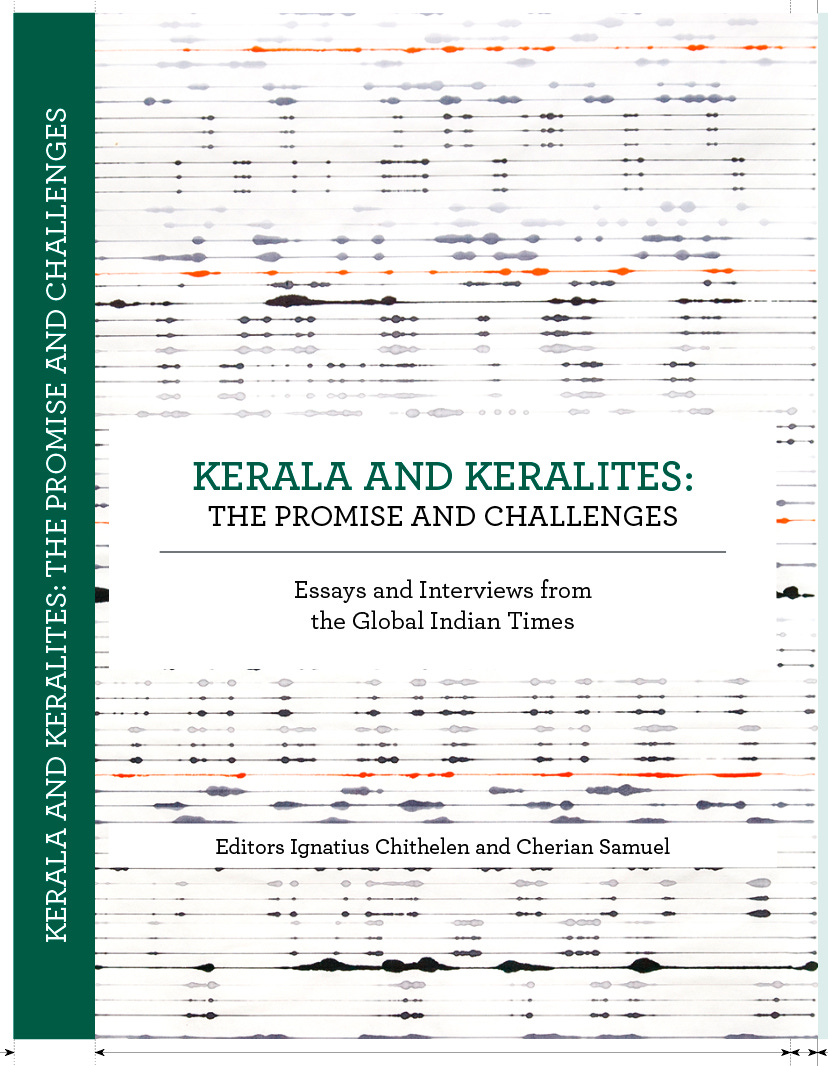
The Kerala and Keralite book profiles 21 accomplished scientists, economists, business founders, chief executives, TP Sreenivasan, former Indian ambassador to the UN, those in the arts as well as cricketer Sanju Samson. So, the book offers insights on their education and career choices and overcoming obstacles and failures. This is a valuable resource for young Keralites and others said Ignatius Chithelen. He is the publisher of Global Indian Times.
In education, expanding funding for liberal arts college programs is a waste of scarce funds, added Chithelen. It merely generates more graduates who cannot find jobs. Already, Kerala has roughly 650,000 unemployed graduates, according to Kerala Government data. The actual number is likely far higher.
There is a clear alternative, Chithelen noted. A major achievement, resulting from Kerala’s long-established focus on education, is that Keralite women are a major beneficiary of the rising global demand for nurses. Kerala should use its scarce funds to set up globally recognized, jobs-related, skills training programs, for post-high school students. Such as emergency medical staff, electricians, plumbers, and welders. Thousands more Keralites can then find work, in India and abroad, similar to nurses.
There is the Kerala Model of Economic Development, the Gujarat Model and so on, said M Suresh Babu. Can all these models work? Babu is Director, Madras Institute of Development Studies, Chennai, India.
We need to look at Kerala plainly as a society of real achievements and serious contradictions, said Paul Kattuman. He is Professor of Economics at Cambridge Judge Business School, University of Cambridge, and Director of Studies in Management and Fellow of Corpus Christi College, Cambridge.
The Kerala Question is no longer whether human development matters, adds Kattuman. It is whether Kerala can turn human development into secure livelihoods, greater autonomy for women, environmental security, and a future that more people can imagine within Kerala itself.
Cherian Samuel is co-editor of Kerala and Keralites.