

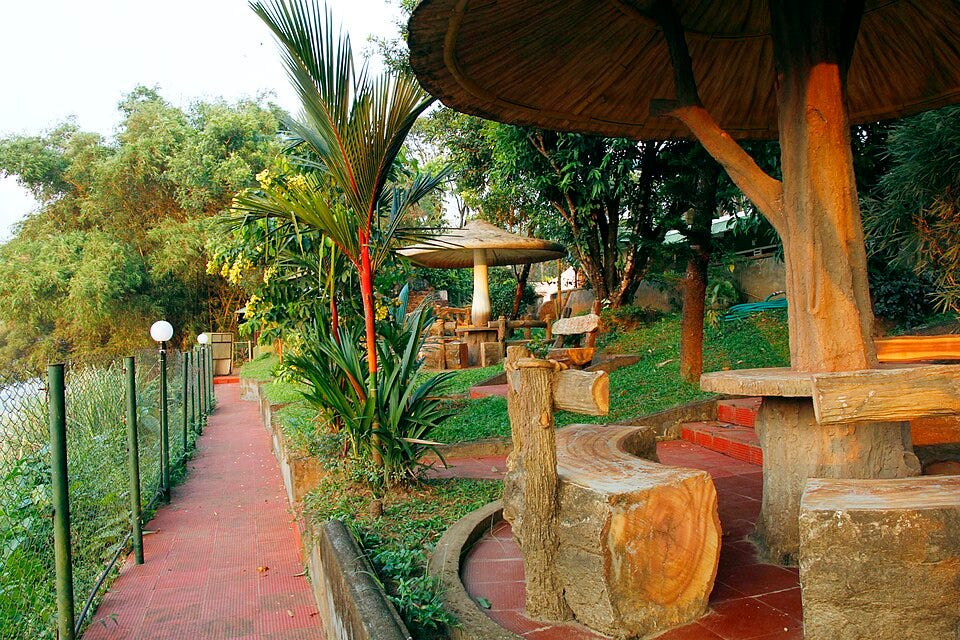
(Photo: an Ayurveda resort in Kerala, courtesy Wikimedia.)
By Sunil Mani
July 4, 2026
As a Keralite, I view Kerala as God’s Own Country.
Blessed by nature, the state offers a wide range of choices for fun and relaxation. Kovalam, Varkala, Bekal, Marari, and other beaches, along the Arabian Sea coast, which stretches over 600 kilometres, 375 miles. Houseboats plying on the backwaters, an interconnected network of lagoons, lakes, rivers, and canals, especially in Alappuzha and Kumarakom. Miles of trails for trekking in the hill-stations of Munnar, Thekkady, and Wayanad, in the Western Ghats. Protected forests like the Periyar Tiger Reserve and Eravikulam and Silent Valley National Parks. In the forests and hill stations you may see elephants, bison, deer, and other wildlife and hornbills, kingfishers, orioles, and other birds.
Kerala also has the Thrissur and other Hindu temple festivals, major Christian pilgrimage centres such as Malayattoor, Bharananganam, Edappally, Vallarpadam, and Arthunkal, as well as colonial and Jewish sites in Fort Kochi.
In turn, over centuries, Keralites have advanced the use of Ayurvedic and other nature-based remedies to treat back and joint pain, allergies, diabetes, insomnia, stress and other ailments. They grow jackfruits, mangoes, pineapples, cashews, and other fruits. A long tradition of cooking offers toddy-appams, coconut-based fish and meat curries, payasams and halvas. Visitors are entertained with Kathakali, Mohiniyattam, Theyyam, Kalaripayattu, and other dances and cultural attractions.
Not surprising then, that, tourism and medical tourism are an important pillar of Kerala’s economy. It is one of the state’s largest employers, generates thousands of small and several big entrepreneurs, contributes significantly to a more balanced economic development across the state, and earns foreign exchange for India.
Kerala is popular with tourists from India as well as abroad. Domestic visitors rose to 25 million in 2025, exceeding the pre-Covid 19 pandemic record of 18 million. More than two-thirds of the domestic tourists are from within Kerala. They are a mix of day travellers and those renting overnight rooms, during weekends, school holidays, and Onam and other festivals.
The rest of the domestic tourists are mainly from the neighbouring southern states, especially Tamil Nadu and Karnataka, and some from the other states. Visitors from neighbouring states typically spend two to three nights in Kerala, while those travelling from more distant parts of India stay four to seven nights.
Most foreign tourists stay longer, often one to two weeks, especially those combining Ayurveda treatments with leisure travel. In 2025, foreign tourist arrivals were 822,000, about a quarter below the pre-pandemic peak.
Kerala’s attraction has grown rapidly since the 1990s. In 1999, foreign visitors were around 200,000, up more than three-fold from 1990. Domestic tourists were around five million in 1999, up more than five-fold from 1990.
In 2025, Kerala’s total revenues from domestic and foreign tourists were an estimated Rupees 50,702 crores, US $5.4 billion. This was about four percent of the state’s Gross Domestic Product. The revenues are up 120-fold from 1999, in Rupees, in large part due to spending by foreign tourists and the depreciating Rupee. In 2025, while foreign tourists were only around three percent of arrivals, they accounted for nearly a sixth of the state’s tourism revenues.
Foreign tourist arrivals are seasonal, starting in November and extending until March. Among domestic tourists, there is big demand, especially for Kerala’s hill stations and beaches, during the summer school holidays in April and May. There is a second peak in domestic tourists from September to January.
The British account for nearly a sixth of Kerala’s foreign tourists, followed closely by Americans. The state also attracts tourists from Germany, France, Malaysia and Australia. In recent years, Arab tourists, mainly from Oman, Saudi Arabia, and the United Arab Emirates, account for nearly a fifth of foreign tourists. A substantial proportion of foreign visitors are non-resident Indians, particularly Keralites, returning to visit family and friends as well as for leisure and medical care.
Idukki district, where Munnar and Thekkady are located, attracts nearly a fifth of domestic tourists. Other popular destinations are Ernakulam, with Kochi and Fort Kochi, Thiruvananthapuram, with Kovalam beach, and Thrissur, home to the Guruvayoor temple. These four districts account for more than two-thirds of domestic tourist visits to Kerala. These districts are also popular among foreign tourists, though Ernakulam attracts more than a third of them.

(Photo: dance, Kerala, courtesy Wikimedia.)
The Government of India has liberalized visa regulations, including offering visas-on-arrival to citizens of Japan, South Korea, and the UAE. Each week, during the peak tourist season, roughly 700 to 800 direct international flights arrive at the Kochi, Thiruvananthapuram, Kozhikode, and Kannur airports. The Kochi airport handles nearly half of them. The flights mostly originate in Dubai and other Gulf countries. In addition to tourists, the four airports serve Keralite expatriate laborers traveling to and from the Gulf. This has sharply reduced the cheating and robbing of many of these laborers which previously occured at the Mumbai airport.
Kerala has more than 4,000 government-approved tourist accommodations, with an estimated 70,000 rooms. They include hotels, resorts, villas, houseboats, and guest houses. Hotels, catering mainly to foreign tourists and affluent Indians, have around 10,000 rooms. They range from upscale Hyatt, Le Meridien and Taj hotels, to mid-price Crowne Plaza, and Ramada, and budget hotels, including those run by local entrepreneurs, like the Abad Hotels. Kerala also has around 9,000 licensed Airbnb and other similar short-term home and room rentals.
Prices vary depending on facilities, location, and season. In 2026, off-season daily room rates at the Grand Hyatt in Kochi started from Rupees 17,000, $170. Rates at the Kerala Government run KTDC-Bolgatty Palace & Island Resort, in Kochi, ranged from Rupees 4,000 to 6,500, $40 to $65. Mid-range resorts such as Golden Peak at Ponmudi charged Rupees 2,200 to 6,500, $22 to $65. Guest houses and Airbnb rooms were available for Rupees 800 to 3,000, $8 to $30, per night. During the monsoon season, June to September, tourists can get discounts of 20 to 50 per cent.
While the monsoon months are off-season for leisure travel, they are peak season for medical tourism. Kerala is by far India’s leading destination for such tourists. Ayurveda facilities offer Panchakarma, a five-part cleansing and detoxification treatment, physical rehabilitation and stress-reduction therapies, oil-massages, yoga, and meditation.
Each year, Kerala attracts several hundred thousand visitors primarily for medical and wellness treatment. They are foreigners, non-resident Indians, including those returning from the Persian Gulf countries, and affluent Indians. Most of the foreigners are from Germany, France, Switzerland and the UK. In 2024, medical tourism in Kerala generated an estimated Rupees 13,500 crores, $1.4 billion, in revenue.
Kerala has one of the largest number of nature-based medical professionals in the world. They include some whose families have practiced Ayurveda for generations. Also, each year, the state’s twelve Ayurveda medical colleges graduate around 700 practitioners as well as post-graduate specialists. Government and private colleges annually train hundreds of Ayurveda nurses and therapists.
Ayurvedic traditions include formulating medicines, using herbs and spices, which are found locally. So, there are thousands of pharmacists, medicinal-plant cultivators, and researchers, including those working in hospitals, teaching institutions and pharmaceutical companies.
The state has more than 900 government-accredited Ayurveda hospitals, treatment centres and resorts. They offer an estimated 9,000 treatment and accommodation beds, ranging from internationally renowned medical resorts to small physician-run centres.
The luxury Somatheeram Ayurvedic Health Resort is located near Kovalam. During the 2026 Monsoon season, daily rates ranged from US $134 for a cottage, for two adults, to $272 for a deluxe suite for three adults. Rates are higher during the peak tourist season, December to March. Packages, which include rooms, meals and choice of thirty different Ayurvedic treatments, are higher in price. The prices though are not listed on the site, with potential guests having to seek a quote by email.
The resott, which caters primarily to German and other western guests, is run by a German-Indian management team. Bookings can only be made through its website and office and via “expert partners.” Since the founder Polly Mathew passed away in 2015, his sons and wife Tresa Arampankudy manage the business.
Nearby, there is Somatheeram Ayurveda Village run by Baby Mathew, the brother of Polly Mathew. During the Monsoon season, daily rates range from $75 to $250. The village offers reservations through Expedia and other travel sites. The Mathew brothers, who founded the original Somatheeram, split in 2006.
Kerala has budget ayurveda hospitals and wellness centres, some operated by charitable trusts and physician-owned clinics. They charge Rupees 2,500 to 5,000, $25 to $50, per night, during the monsoon season, and, Rupees 3,500 to 6,500, $35 to $65, during the peak season. The rates at some of the facilities include accommodation, meals, doctor’s consultations and one or two daily treatments.
Kerala also has internationally accredited, multi-specialty hospitals These include the VPS Lakeshore Hospital, Ernakulam and Kochi, Aster MIMS Hospital, Kozhikode, and Amrita Hospital, Ernakulam. They offer heart surgeries, organ transplants and other modern allopathic care. The hospitals mainly attract patients from the Persian Gulf, including non-resident Indians.
Tourism in Kerala, as in other places, generates demand for taxis, food, retail stores, handicrafts, construction, and other businesses. Using data from an earlier study, it is estimated that tourism and related businesses provide roughly 1.6 million jobs in Kerala. This accounts for nearly a quarter of the state’s total formal and informal employment. In Idukki, Ernakulam, Alappuzha, and Wayanad districts, tourism has reduced dependence on traditional agricultural jobs.

(Photo: boat race Kochi, Kerala, courtesy Wikimedia.)
Tourism has boosted entrepreneurship in Kerala in a number of related businesses. There are private owners of hotel chains such as Abad Hotels, CGH Earth, Casino Group, and Raviz Hotels. Room rates at Abad, a chain of 16 hotels and two premium houseboats, ranged from Rupees 4,500 to 6,500, $45 to $65, during the 2026 peak season; and Rupees 3,000 to 4,500, $30 to $45, during the off-season.
Abad Hotels is part of the Kochi-based Abad Group, run by Managing Director Riaz Ahmed, a fifth generation descendant of the founding family. The group’s origins were a dried-fish exporting business, started in Kerala in 1932, according to OnManorama. The group also owns Abad Builders which has developed 48 residential buildings, with more than 3,000 apartments.
Spurred by demand from tourists, Keralites have set up roughly 37,000 restaurants, ranging from small, roadside eateries to cafés and fine-dining spaces, including in hotels. There are also chains, including Paragon, Salkara and M Grill.
The price of a breakfast of idli, dosa, appam or puttu, with coffee or tea, at a road-side restaurant, range from Rupees 80 to 200, $0.80 to $2, per person. Lunches at mid-range restaurants cost Rupees 250 to 600, $2.50 to $6, per person. Breakfast at the KTDC resorts, such as Tea County, Munnar, and Samudra, Kovalam, cost around Rupees 500, $5, and lunch or dinner, Rupees 700 to 850, $7 to $8.50, per person.
Serving of beer, wine, and spirits is more restricted in Kerala than in other parts of India, including Goa, another popular tourist destination. Alcohol is served only by premium hotels and resorts and licensed restaurants.
As the appeal of Keralite food has risen, there are more than a hundred high-end hotels, resorts, and Ayurveda facilities which offer cooking classes to prepare appam, fish curry, halvas, and other dishes.
In the Ayurvedic field, several entrepreneurs, who initially set up treatment resorts, have expanded into manufacturing and selling branded Ayurvedic medicines, herbal cosmetics, massage oils, nutraceuticals, health foods and wellness beverages. There are now more than 500 such manufacturers in Kerala. They include the Arya Vaidya Sala, Kairali Ayurvedic Group, and Vaidyaratnam Oushadhasala. Arya, based in Kottakal, manufactures more than 530 formulations, including for pain management, boosting immunity, eye care, and baby care. The formulations are available in nine categories, including fermented, powdered herb, pill, and oil-based.
As the population ages, demand for Kerala’s nature-based healthcare services will grow, likely making tourism an even larger part of the state’s economy.
However, Kerala’s tourism industry faces major challenges. They include congested roads, impact of climate-change, and, most important, competition from Sri Lanka, Vietnam, Thailand, and the Maldives.
Up until a decade ago, Kerala was far cheaper for foreign tourists. In 2026, the total costs for a ten-day trip, for a British or American couple, to Kerala, Vietnam and Sri Lanka are roughly the same.
Travel to Kerala is becoming more expensive due to higher costs, especially of unskilled labor and real estate. Daily wage rates in Kerala are among the highest in India. It is being driven up by a combination of powerful labor unions and a highly educated workforce, which avoids manual labor. Ironically, Kerala, which exports labor to the Persian Gulf countries, imports unskilled labor - around three million - from the poorer regions of Bihar, West Bengal, and other Indian states.
Then, demand for homes and other real estate in Kerala keeps rising, from relatively affluent Keralites working outside the state, especially those in the Persian Gulf countries. This has sharply boosted prices of land and construction costs.
There is then climate-related risks, though this also applies to competing tropical tourist destinations. In 2019, for instance, the summer and monsoon tourism business, across much of Kerala, was severely hurt by heavy rain, floods, and landslides. There was also a highly publicized outbreak of the Nipah virus and fears of flood-related communicable diseases, particularly leptospirosis (rat fever), dengue fever, influenza, and hepatitis A.
Given the challenges, entrepreneurs, officials, and policy makers in Kerala must recognize that the state’s advantages in tourism needs to be nurtured and strengthened, or it can evaporate quickly. There are no compelling reasons for foreign tourists to spend their money in Kerala. Sri Lanka, Vietnam, Thailand, and the Maldives also offer beaches, forests, and birding, good food, and massages, yoga, and other nature-based wellness treatments.
The example of the cashew industry in Kerala offers a good lesson. In the mid-1990s, Vietnamese delegations visited Kollam to learn about Kerala’s cashew nut processing operations. By 2006, using automation and favourable government labor and other policies, Vietnam overtook India as the leading exporter of cashew nuts. Meanwhile, Kerala’s cashew agro-industry was unable to cut costs and improve quality, severely damaging the state’s centuries-old dominance in the global supply of the nuts.
Unlike Vietnam and Sri Lanka, Kerala offers a rare blend of ancient, proven Ayurveda-based medical services and numerous leisure attractions. Will Kerala’s advantage soon disappear due to complacency and neglect or since it is being copied by rivals? Or, will those in Kerala’s tourism business focus on improving quality and services and lowering costs, thereby continuing to attract more foreign tourists?
Sunil Mani is a visiting professor, Centre for Development Studies, and Ahmedabad University, both in India. The views expressed are personal.
This essay will be part of the book, Kerala and Keralites: The Promise and Challenges. The book is a collection of essays and interviews from the Global Indian Times, edited by Ignatius Chithelen and Cherian Samuel. Bryant Park Publishers. Publication date July 2026.