
Why Rising Foreign Demand for Nurses Benefits Keralite Women
Foreign demand for Keralite nurses will continue to rise while that for Indian engineers may decline says Sunil Mani

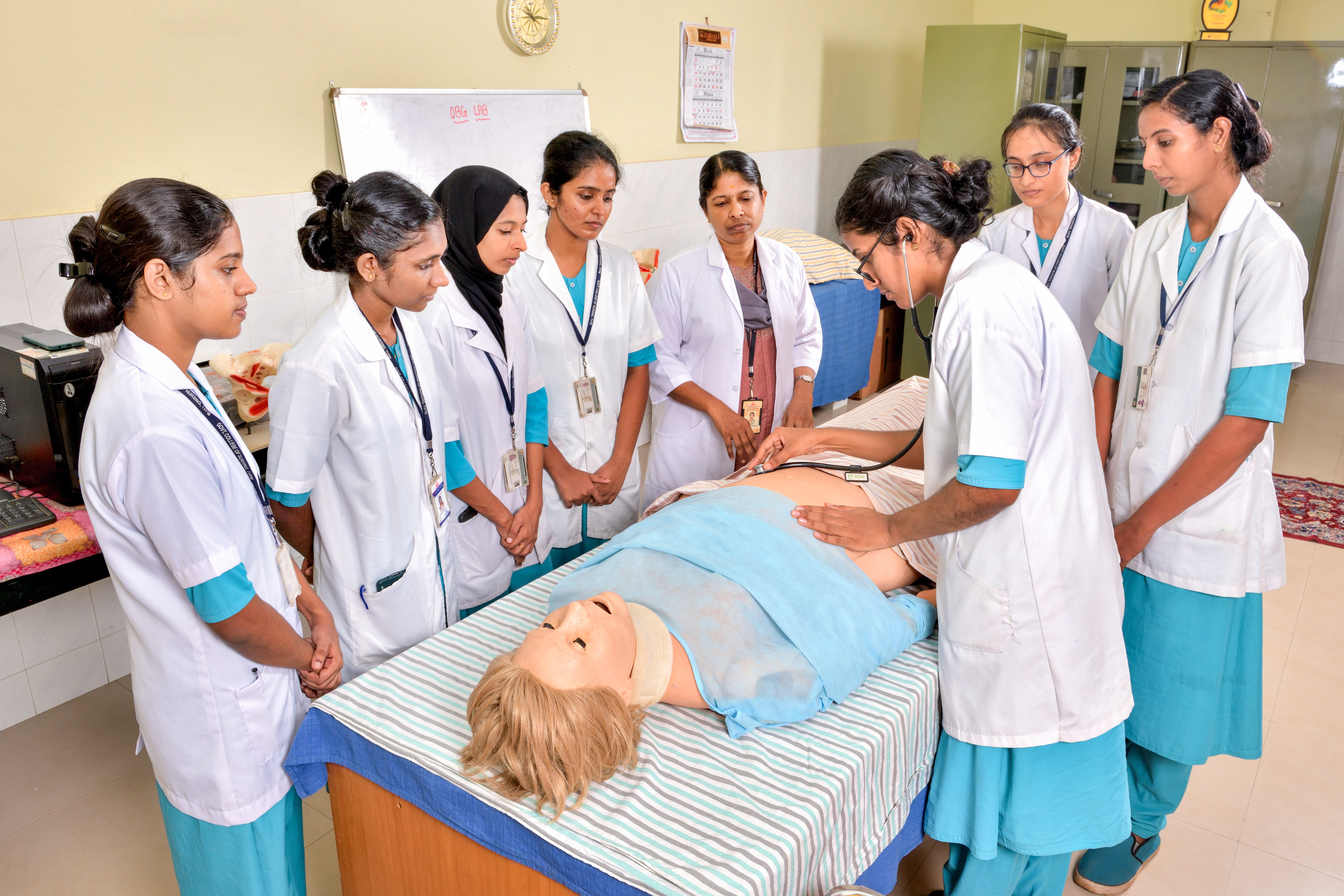
(Photo: a simulated training session at the Government College of Nursing, Thiruvananthapuram, Kerala; courtesy college.)
March 14, 2026
by Sunil Mani
Earlier this month, hundreds of nurses from nearly 490 private hospitals and healthcare clinics across Kerala went on strike. Their main demand is raising the minimum basic salary to Rupees 40,000, $430, per month, up from Rupees 25,450, $270, which has been unchanged since 2018. They also seek hiring of more nurses to reduce extra-long work hours, improve patient nurse staffing ratios, and no dismissals of nurses, especially union organizers.
The strike, led by the United Nurses Association, is ongoing. While regular medical services at the facilities are disrupted, care is being provided to emergency patients.
In addition to the demands of the nurses, the strike brings attention to the major role of Keralite nurses in the state’s economy and in healthcare services in many parts of the world. Neither the governments of Kerala or India track the number of Keralite and Indian nurses working in foreign countries. A rough estimate, based on earlier studies, points to more than 300,000 Keralite nurses employed abroad. This makes them the largest number of migrant Indian professionals after engineers.
While Keralites are less than a tenth of the nurses in India, they account for nearly nine out of ten Indian nurses employed in foreign countries. Kerala is likely the second largest source of nurses around the world, after the Phillipines. With almost all the nurses being women, they make up the largest number of Indian women professionals working abroad.
More than half of the Keralite nurses working abroad are employed by healthcare systems in the Persian Gulf countries, mainly Saudi Arabia, United Arab Emirates, Kuwait, Qatar, Oman, and Bahrain. Following the COVID-19 outbreak, there has been rising demand for Indian nurses in the Western countries. In 2022, for instance, roughly 25,000 of them found jobs in the United States and Europe. More Indian nurses are also being hired in other Western countries, including Canada which annually offers work visas to more than 20,000 foreign healthcare workers.
In 2025, there were 900 nursing candidates from India hired in Germany, with another 700 expected to be deployed this year. Also, last year, United Kingdom’s National Health Service hired 200 healthcare workers from Kerala, after hiring 300 the previous year. Christian missionaries working in Kerala, especially Roman Catholics, enable the hiring of Keralite nurses in Germany and Italy Indian nurses are also employed in Asia, Africa, and Latin America.
India has roughly 5,800 nursing colleges and schools, annually graduating more than 200,000 students with degrees and diplomas. But much of the demand from high-paying, major healthcare facilities in India is for graduates of the top 200 reputed institutions, which account for roughly a tenth of the students. They include the All India Institute of Medical Sciences, Jawaharlal Institute of Postgraduate Medical Education and Research, Pondicherry, and Christian Medical College, Tamil Nadu.
The bulk of foreign hiring of Indian nurses is carried out by private agencies in India, working on behalf of foreign employers. The agencies are required to register with the Government of India and are subject to other rules aimed to protect the nurses. Yet, there are regular news reports of nurses, who are eager to find jobs abroad, being swindled by scammers.
A major scam occurred in 2014. Four men from Kerala were arrested for collecting Rupees 232 crores, $25 million, from thousands of nurses for a fake job placement program in Kuwait. Their agency, Al Zarafa Manpower Consultants, provided forged job recruitment and other documents. The nurses, who spent money to travel to Kuwait, found there were no jobs. Worse, each of them lost Rs. 20 lakhs, $22,000, they and their families likely borrowed to pay the placement fees demanded by the scammers.
In the 1970s, demand for Indian nurses began surging in the Persian Gulf countries, during the economic boom in the region which was fueled by rising crude oil prices. Demand remained strong in these countries till the mid-2010’s. Then in 2014, the Indian government restricted Indian nurses from taking up jobs in eighteen Persian Gulf countries, including Saudi Arabia, UAE, and Oman due to reported underpayment of salaries, long hours and extreme work conditions, and alleged physical and sexual assaults.
Agencies of both the Governments of India and Kerala attempt to protect nurses from being exploited by foreign employers and from recruiting scams. But their efforts are relatively small.
For instance, the Overseas Development and Employment Promotion Consultants placed only about 3,100 nurses for jobs in the Persian Gulf and Europe over six years ending 2024. Similarly, the Non-Resident Keralites Affairs Department placed only 2,540 nurses in foreign countries from 2018 to 2023. Both Kerala government agencies charge a small fee, which covers leads to potential foreign jobs, certification of nursing qualifications, and, if needed, some initial foreign language training.
Keralite nurses working abroad make a major contribution to Kerala’s income. So it is odd that the state government also does not track their annual remittances to families, bank and investment accounts, and for home purchases.
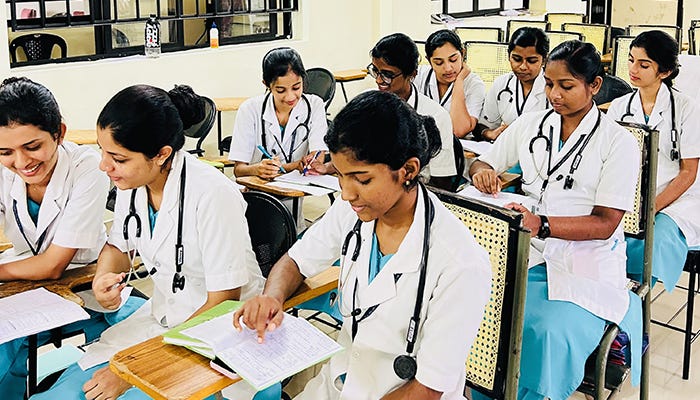
(Photo: nursing students at the Government College of Nursing, Ernakulam, Kerala; courtesy college.)
Foreign employers seek to hire Indian nurses with a nursing degree, preferably after a science degree, proficiency in spoken and written English, and experience, in addition to their usual criteria of skills, work habits and good recommendations.
Keralite women have several strengths for finding nursing jobs both in India and abroad. Most of those who study science in college are very interested in pursuing a nursing career. They are eager to acquire a skill like nursing which will enable them to find long-term jobs, amidst the high unemployment in India, including among women with science degrees.
From an early age, many women in Kerala have some knowledge of nursing and what steps to take to earn a degree or diploma, due to regular chats with relatives and friends who work as nurses, including in foreign jobs. Many of them also have a proficiency in English since they attended English language schools from an early age. Some of them also imbibe the rich tradition of patient care skills which are native to Kerala, given its renowned, age-old ayurvedic health treatments, which continue to remain a big attraction for foreign tourists.
But there is intense competition for admissions to the government-recognized nursing colleges in Kerala, including requiring to finish at the top among several thousand students who take the high-pressure entrance exams. Each year only about 4,000 degree and diploma students are admitted by the 131 government-recognized nursing colleges in Kerala for the General Nursing and Midwifery programs.
About a third of the colleges are run by the government. The rest are run privately with some being affiliated with hospitals run by Christian and other religious non-profit institutions. The Government Colleges of Nursing in Thiruvananthapuram, Kozhikode, and Kottayam are highly sought after. Reputed private institutions include the Lourdes College of Nursing in Kochi.
Each year, healthcare facilities in Kerala hire only about a tenth of the state’s nursing graduates. The rest have to find jobs in other states in India, with some hired overseas. An additional 10,000 Keralite women attain nursing qualifications in other states, especially in neighboring Tamil Nadu and Karnataka.
There are also several privately run nursing colleges and schools, many for-profit, in Kerala as well as in other states. But their degrees and diplomas, which are not recognized by government agencies, have little value and their fees are very high.
In 2025, more than 2,000 vacancies for junior nursing positions in central government-run healthcare facilities remained unfilled for three years, according to a report in India Today. India’s healthcare facilities will need to hire more than a million nurses if they are to meet the World Health Organization’s recommended ratio of three nurses per 1,000 population. The ratio is roughly 2 per 1,000.
There is a shortage of quality nurses and other healthcare staff not just in India but around the world, including in the western countries. The demand will continue to grow due to the rising medical needs of a rapidly aging global population.
Equally important, nursing requires physical and labor skills as well as medical knowledge and experience. So, most aspects of nursing jobs are not being automated by the rising use of robots and artificial intelligence tools. This makes a nursing career far more attractive even when compared to most engineering careers. Already, Indian engineers, including some graduates of the top colleges, are having trouble finding jobs. Demand for them in the US and other Western countries is sharply declining, especially for desk-based software and information technology skills, which are being rapidly automated.
Both the Government of India and the Kerala government are expanding capacity at nursing colleges and setting up new ones. In 2023, the Government of India approved 157 new nursing colleges, co-located with medical colleges, including with an annual capacity of 15,700 reserved for students from tribal and lower caste families. The central government has also approved funding for 113 new nursing colleges to be set up by various states. In 2025, the Kerala government announced plans to add roughly 600 more seats for BSc at existing nursing colleges.
Kerala’s nursing heritage dates back a century with the first nursing school, the Ernakulam Government School of Nursing, established in 1924 at the Ernakulam General Hospital. The school was founded by the Italian Sisters of Charity, following a request from the Maharaja of Cochin. The graduates of the school have played a major role in building the reputation of Keralite nurses around the World. Admissions to the school, which annually graduates about 40 students, is likely the most competitive among nursing colleges in India.
The high social status of women nurses in Kerala is evident from their being much sought after brides, as also seen in matrimonial advertisements. In fact, there is a specific Malayalam word, kondupokum, used by parents in the matrimonial ads they place for their daughters who are nurses. The word literally means “will carry away.” In the matrimonial ads, it implies, “Our daughter has a prestigious, high-paying job abroad, and we need a groom who is willing to go with her and support that life.”
Sunil Mani is a visiting professor, Centre for Development Studies, and Ahmedabad University, both in India. The views expressed are personal.