
Why is India Competing With Saudi Arabia in Refined Crude Oil Product Exports
India expanding crude oil refining capacity for exports makes little economic sense since it imports almost all of its oil


(Image: Indian Oil Corp logo. Courtesy Wikipedia.)
February 27, 2026
Earlier this month, United States President Donald Trump issued a statement in which he agreed “to remove the additional 25% tariff on imports from India in recognition of India’s commitment to stop purchasing Russian Federation oil.”
As a result, India’s cost of oil imports will rise. In 2025, India bought 1.7 million barrels of oil per day from Russia, nearly a third of its total consumption, at a discount of $5 or more per barrel compared to Brent benchmark prices. The current Brent price is $73 a barrel. The higher cost will hurt India’s economy since the country imports 90 percent of the 5.4 million barrels of oil it consumes per day. In fiscal year 2025, India’s oil imports totaled $140 billion, which partly boosted its merchandise trade deficit to $284 billion.
Starting in about a decade, there is a high probability that oil prices will be in a long-term decline, though there could be short-term spikes due to geo-political and supply demand factors. Futures prices in the late 2030’s are far lower than the current price, though on small trading volumes.
Oil prices are likely to decline because global demand stays flat, perhaps declines, as more automobile buyers switch to electric vehicles, especially in China which is the world’s largest auto market. U.S. investment bank Goldman Sachs forecasts demand to peak in 2040 at around 113 million barrels per day, up from 105 million barrels today. Meanwhile, on the supply side, global recoverable oil reserves will remain abundant at more than 1,500 billion barrels.
By 2050, India’s crude oil consumption is forecast to nearly double to 9.2 million barrels per day, according to a government report. Unless there are discoveries of major domestic reserves, which is highly unlikely, India’s oil imports will jump to around eight million barrels per day. So, even if prices drop, India’s total oil import bill may rise, enlarging its trade deficit and foreign debt.
Almost all of India’s oil imports are refined domestically by government-run and privately owned companies into diesel, gasoline, jet fuel, naphtha and other value added products. Their current annual capacity is 258 million metric tonnes. So a decline in oil prices could benefit India’s economy since it imports most of its oil and refines it domestically. But to benefit, the Government of India needs to restrict oil imports to the quantity needed to meet domestic consumption.
However, about 1.2 million barrels a day, more than a quarter of India’s oil imports, is refined for exports. By 2030, Indian refiners plan to nearly double annual capacity to more than 450 million tonnes, according to a government report. Part of the new capacity is to meet rising domestic demand for diesel, gasoline and other refined products. The government also has ambitious plans for India to continue to be a major exporter of refined products. The rationale is that Indian exporters will benefit since they will replace capacity which Western countries may shut to meet their green energy goals.
To meet the new capacity goal, Indian refiners will have to spend more than $125 billion in capital investments, according to rating agency CRISIL. The Government of India will have to fund such investments since most of the new capacity will be installed by government-run companies.
The risks of expanding India’s refined products export capacity, based not on cost benefit analyses, but on speculation of what other governments may or may not do are already evident. Recently, the Trump Administration and some other Western governments abandoned their green energy goals. So, there will be far fewer shutdowns of crude oil refining capacity in the West than previous estimates.
More important, it makes little economic sense for India to spend scarce capital to boost exports of refined products and compete against giant, low-cost Persian Gulf and Russian competitors. For instance, the average cost of a barrel of oil for Russian producers is $15, and, for Saudi Arabia’s Aramco, it is between $2 and $10. In contrast, Indian refiners pay five to fifteen times more for each barrel they import. Also, since refining is an energy intensive operation, production costs are far higher in India than in Saudi Arabia and Russia. Saudi Arabia exports around seven million barrels of crude and crude products per day while Russia exports around five million barrels.
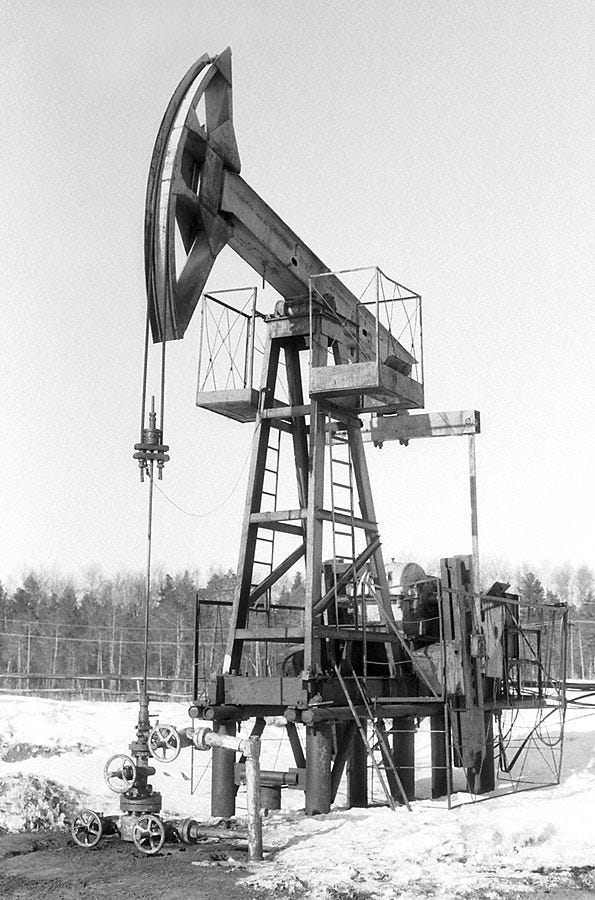
(Photo: An oil rig in Russia, courtesy Wikimedia Commons.)
Meanwhile, Saudi Arabia and the other Persian Gulf exporting countries are expanding their refining capacity to secure more of the processing value. By 2030, they plan to add 618,000 barrels per day of new capacity, raising their refined products output to a net six million barrels per day, according to S&P Global. As a result, they will be exporting nearly a third of their crude oil output as refined products.
By 2035, even if oil prices decline by half, the input costs for Indian refiners will remain at least three to seven times higher than that of their Russian and Saudi competitors. Indian refiners are forecast to continue exporting more than 1.2 million barrels of products per day.
Already, there is evidence that India is at a disadvantage in competing against low-cost rivals. In fiscal year 2025, the prices received by Indian exporters were sharply lower. As a result, that year the value of India’s refined product exports fell to roughly $44 billion, less than half that in fiscal year 2023, even though volumes were a fifth higher at 120 million tonnes.
Such a sharp decline in revenues implies that Indian refiners exported some, if not all, of their products at a loss. This raises a question: is it the government-owned companies - which account for nearly two thirds of India’s refining capacity - who are exporting at a loss? Private companies will export at a loss only if government subsidies and/or tax-benefits ensure they earn profit margins of at least 12%, which is typical for their sales in India.
As oil revenues decline in the Persian Gulf countries, they will likely hire far fewer foreign laborers, including Indians. This will worsen India’s unemployment, especially in Kerala whose economy depends on remittances from workers, mainly in the Persian Gulf, for about a fifth of its income.
The Indian government, which is apparently absorbing the losses on refined products exports, should avoid funding the expansion of refining capacity for exports. Instead, it should use the funds to finance businesses which solve key economic bottlenecks while creating jobs. For instance, India acutely needs a cold-chain to extend the life of vegetables, fruits, meat, dairy, food grains and other farm products. Expanding the cold chain will likely bring in far more export revenues than refined crude oil products, and that too profitably, since India is a major low-cost producer of agricultural and food items. Also, it will help reduce wastage of food produce in India - more than a third is wasted - an estimated annual loss of $26 billion.
In about a decade or so, as crude oil prices begin a sustained decline, India faces an economic hit even though it ought to benefit as an importer of the commodity. Will the Government of India abandon plans to become a major exporter of refined products, where the country has no economic advantage?
Story updated February 28, 2026.