
Good Writing Helped TP Sreenivasan’s Career in the Indian Foreign Service
TP Sreenivasan says he would still choose Government Service over a corporate career

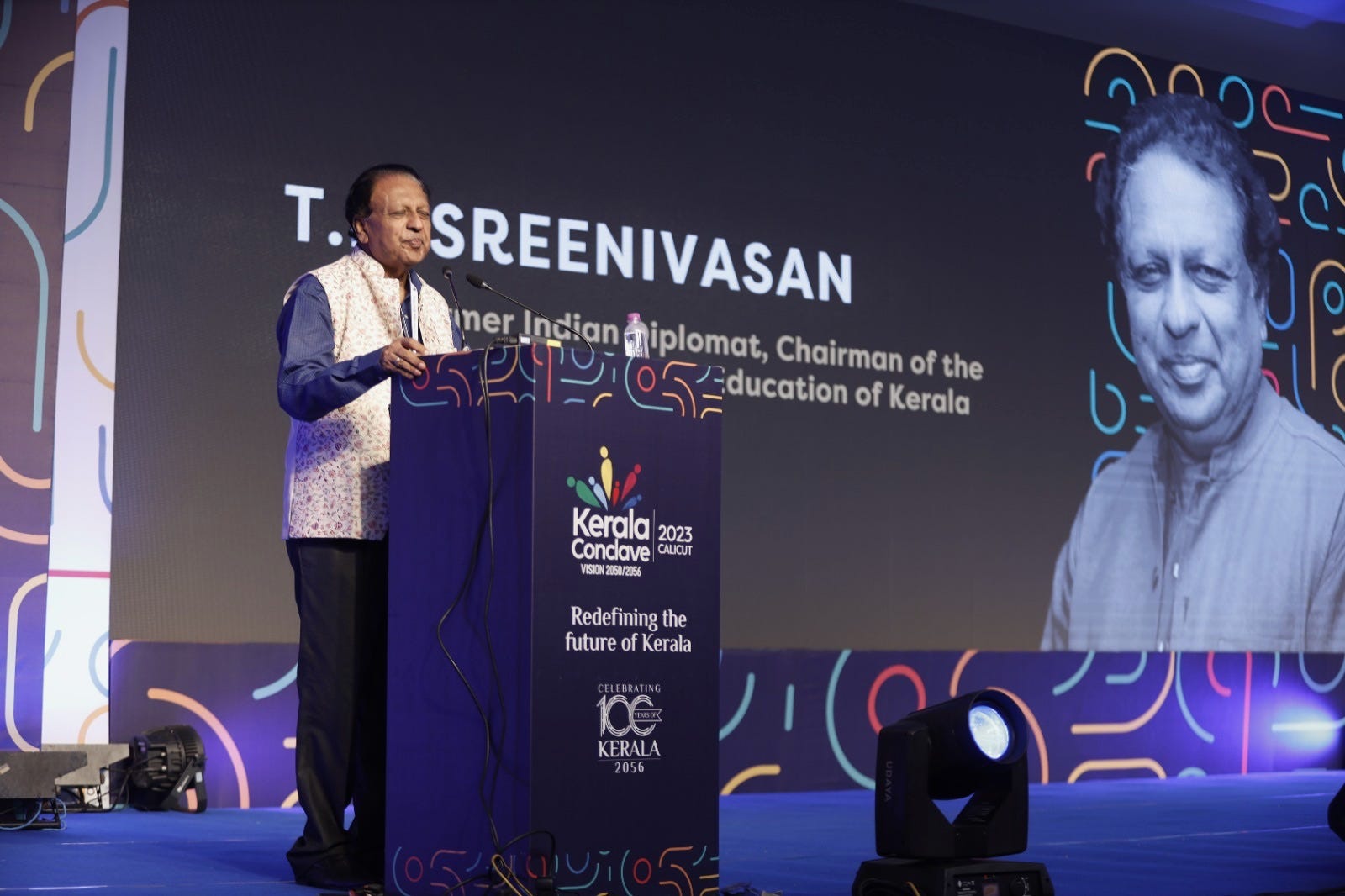
(Photo: TP Sreenivasan, at an Education Conference, Kerala. All photos © Sree Sreenivasan.)
July 12, 2026
TP Sreenivasan is the Director General of the Kerala International Centre in Thiruvananthapuram. Earlier, while in the Indian Foreign Service, (IFS), he was Ambassador to the United Nations, New York, and Governor for India, at the International Atomic Energy Agency, Vienna.
After retiring, TPS, as he is called, was the host of a weekly Malayalam television show on international affairs, Videsha Vicharam, which aired on Asianet News. He was Executive Head of the Kerala State Higher Education Council, 2011 to 2016, and a member of the National Security Advisory Board of the Government of India.
During his 37-year-career in the IFS, 1967 to 2004, his postings included Ambassador to Austria and Slovenia and Deputy Chief of Mission, Embassy of India, Washington DC. He also held postings in Kenya, Fiji, Thimphu, Moscow, and Yangon.
TPS, 82-years-old, started his career as the Third Secretary in the Embassy of India, Tokyo, 1969-71. While in Tokyo, he passed an advanced examination in Japanese with distinction. He also speaks Russian. An author of twelve books, he writes for the Asia Wall Street Journal, Times of India, Tribune, and Rediff.com.
He taught English for a year at Mar Ivanios College, after earning an MA and BA, in English, from University College, Thiruvananthapuram. Thettalil Parameswaran Pillai Sreenivasan, was born in Kayamkulam, Kerala.
In this Global Indian Times interview, while visiting New York in July 2026, TPS chats about his interest in education policies, life in the diplomatic service, how his command of English helped with the civil service exam and his foreign service career, and his writing, including finishing wife Chandralekha’s memoir.
Global Indian Times: What did you enjoy most as a diplomat?
Sreenivasan: Representing India, particularly at the United Nations. And the travel and meeting people in various countries.
Global Indian Times: Any not-so-good aspects of the work?
Sreenivasan: It is a challenge. You move from country to country every three years. Sometimes very interesting countries, very developed countries; sometimes very developing countries where there are difficulties. But it all evens out at the end.
Global Indian Times: The UN headquarters building (in New York) is behind you. What does it mean to you?
Sreenivasan: I spent about 20 years in the UN. New York twice. Also, in Uganda and Nairobi. And UN agencies in Geneva. The UN has been part of my life. I represented India at the UN for more years than most IFS officers.
I first came to the UN in New York in 1979, with India’s Foreign Minister for the Havana summit of the Non-Aligned Movement. I stayed at the UN Plaza Hotel, which is nearby. And I have spent enough days there to perhaps pay for the hotel itself.
Working at the UN, especially in New York, was a dream. It is very difficult to get the post. You have to be recognized as someone with special abilities.
Global Indian Times: You are also a devotee of Stratford-upon-Avon, Shakespeare’s birthplace in the UK.
Sreenivasan: Shakespeare was part of my life during my academic career. I read and taught his books and acted in the staging of his plays. Knowing his works helped me excel at the civil service entrance exam. My dream of visiting Stratford-upon-Avon was fulfilled during our first family trip to the UK. It was an emotional experience.
Global Indian Times: You titled your first book, your autobiography Words, Words, Words.
Sreenivasan: In Shakespeare’s Hamlet, when Polonius asks Hamlet, “What do you read, my lord?” Hamlet does not say a book or a document. He replies, “Words, words, words.” Words constitute the substance of communication. And in diplomacy, words are most important: spoken words, written words, and unspoken words. And long before I joined the Foreign Service, I decided, if I ever wrote a book, I would use Hamlet’s phrase as the title. But the publisher said the title would imply the book is on phonetics. So, we added the subtitle Adventures in Diplomacy.
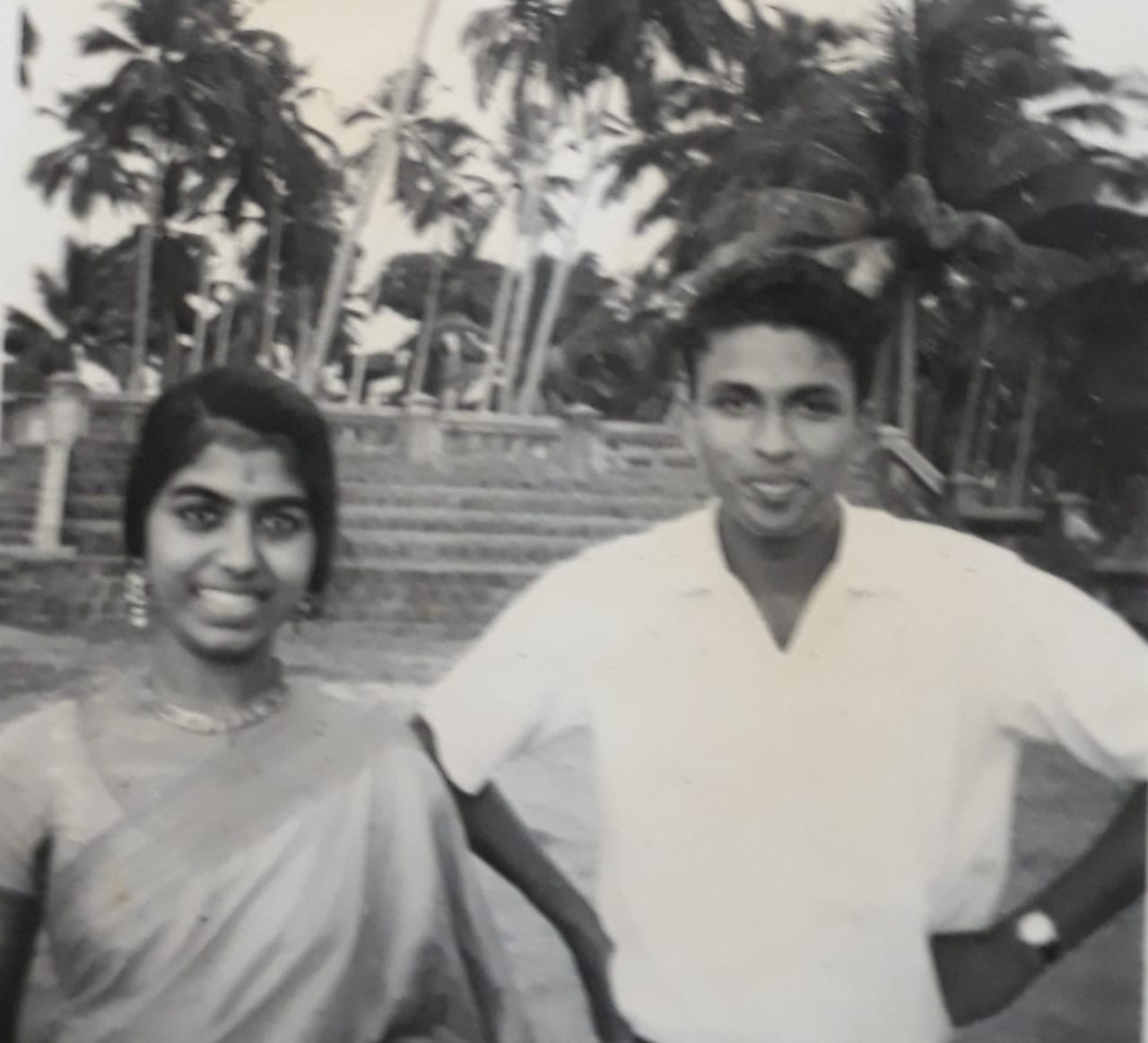
(Photo: TP Sreenivasan and wife Chandralekha, Kerala. 1960s. Photos © Sree Sreenivasan.)
Global Indian Times: You have been busy since retiring.
Sreenivasan: When I retired, I went back to Trivandrum. I wanted to start an academy to train Keralites for the Indian civil service exam. At that time, there was only the Kerala government academy. The Nair Service Society had a similar idea. They invited me to start the Civil Services Academy, which I ran for about 17 years. I helped at least 100 applicants get admission to the Indian civil and other services.
Global Indian Times: What led you to host a TV show on international relations in Malayalam?
Sreenivasan: It was another accident. I had known Dr. Raji Menon (founder of Asianet). He asked me to be the managing director of Asianet, since he was looking for someone who had international credibility. But there were various problems.
At his suggestion, in 2005, I launched Videsha Vicharam, a TV show on international affairs. It ran till 2020, when it was discontinued due to COVID. I then started a YouTube channel, TV with TPS. In 2023, Asianet invited me back and I hosted The Round and Aside.
Global Indian Times: Over 22 years, you have hosted more than a thousand episodes.
Sreenivasan: And then there are shows I do for Tamil, English, and other channels. They ask me about events happening anywhere in the world. Some events I may not even know about since they occurred while I was sleeping. When I say I have to first read about it, they say, “No, we’ll tell you what happened. Give us your reaction.”
Global Indian Times: you have also been involved in education policy in Kerala. Why?
Sreenivasan: In 2011, Chief Minister Mr. Oommen Chandy asked me to lead the Kerala Higher Education Council, a policy-making body. I asked why me, since I only taught a year in college and several Vice Chancellors wanted the post. He said, “I’m not looking for education experience—that we have. Since I am the Chief Minister, people ask me why are we stuck with an old pattern of education? Why can’t you improve it?” And then he added, “Since you know about universities around the world, especially in the United States, you may have some ideas to improve college education in Kerala.”
Along with colleagues, some of whom were Vice Chancellors, we prepared and submitted 16 reports. Our policy suggestions included privatizing colleges, offering them academic autonomy, allowing foreign universities to set up operations in Kerala, and setting up skills-based training programs. Some of them were implemented. Some of the difficult ones are pending.
Global Indian Times: You had an unusual experience as a policy maker.
Sreenivasan: All the states in India, except Kerala, have private universities. Amity University (a private university in India) asked me to explore setting up a private university in Trivandrum. I found it was a hard task because you need the laws changed. Amity gave up.
But Chief Minister Chandy knew of my attempt. We established a committee of former Vice Chancellors and provided a report to the government. But our recommendations were opposed by the left political parties, who were not in power. They campaigned saying I have come from the US and represent international interests. One former Vice Chancellor issued a statement that our reforms would commercialize, commoditize, and destroy Kerala’s education. The opponents ignored the fact that the UN itself recognizes education as a desirable business.
In 2016, I organized a Conference on Global Education. Attendees included 30 heads of US universities. It was held at the Vivanta hotel in Kovalam. When I got to the hotel entrance, I was stopped by a group of around 200 students.
Global Indian Times: You were pushed to the ground?
Sreenivasan: Yes, I fell down after being pushed. But I was not hurt. I got up, and, half an hour later, started the conference. The next day, most major newspapers in India, carried a picture of me, in a business suit, lying on the beach. Tourists at Kovalam can be found relaxing in various costumes. Not in a suit.
A few years later, the left parties were elected to power. Their government sought to implement some of our college reform proposals, though with amendments. It was passed by the Kerala legislature. But, for reasons I do not know, the state Governor is yet to sign it. One of the major goals of the new government (which took office in May 2026) is to reform education, including by attracting the best universities in the world to set up a campus in Kerala.

(Photo: TP Sreenivasan, center, and family on a New York City Subway. © Sree Sreenivasan.)
Global Indian Times: What does it feel like to hold the dozen books you have written?
Sreenivasan: It is a heavy weight, a record of what I did during 37 years in the Foreign Service and 20 years since. Each one is on a subject which is close to my heart, inspired by students, academics, publishers. The writing is always a pleasure. In fact, most of the writing was done while traveling in trains and planes.
Global Indian Times: Would you recommend a civil service career to a college student today?
Sreenivasan: Yes, absolutely. In fact, almost every good student in Kerala sits for the exams. There are some 28 exam preparation academies in Trivandrum alone, using online platforms and tools. They also attract candidates from other states. Some of them are run by my students who did get into the service.
But of course, the odds of being selected are very low. (Only about 0.2 percent of the more than one million candidates get selected.) This year, a girl from Kerala, who ranked 57th, was selected for the Foreign Service. She is from a very, shall we say, poor family. She was one of my students.
Global Indian Times: why is a civil service career attractive when a good student can make more money as an IIT engineer or in a management job?
Sreenivasan: When I joined the Foreign Service (in 1967), I had only two options: teaching or government service. So, the most desirable thing was to try and join the top levels of the civil service.
Today, even with more lucrative career options, the civil service continues to attract many IIT graduates. They find a glamour in running the government or representing India abroad.
Global Indian Times: would you have worked for the administrative or police service?
Sreenivasan: When I applied for the civil service exam, I listed foreign service as my first option, second IAS, and third IPS. But, after I passed the exam, the board of interviewers appeared to favor my joining the police service. That is their usual way of making candidates think they have been selected for the IPS. I spoke of my interest in international relations. I was ranked sixth among the 13 who were selected for the IFS.
Global Indian Times: Up until the 1980s, most who were selected for the top civil service jobs were students of economics, political science, or history. Did studying English hurt your chances?
Sreenivasan: It helped. Where you could not know the facts, you could fictionalize it. That was a great advantage of learning Shakespeare and other English literature. Also, since the exam was in English, it was a test of English knowledge. Later, in the Foreign Service, I found that appreciation of diplomatic notes depended on their literary quality.
Global Indian Times: How did you prepare for the civil service exam?
Sreenivasan: There were no training academies. Most of the preparation was done by seeking answers to questions in previous exams. And adopting learning strategies that helped previous candidates get selected.
But there was a magical tradition at University College. Each year, the student who ranked first in the English MA program, was selected for the civil service. So, when I was ranked first, everybody presumed that I would join the service—so it was kind of a natural move.
Even so, preparation for the exam was very hard. Apart from English literature, I had British history and Indian history as optional subjects. I did poorly in the Indian history exam because I had a superficial level of knowledge. I even thought of giving up on the exam and walking out. But I got a fairly high rank on the personality test, or interview, About 86%.
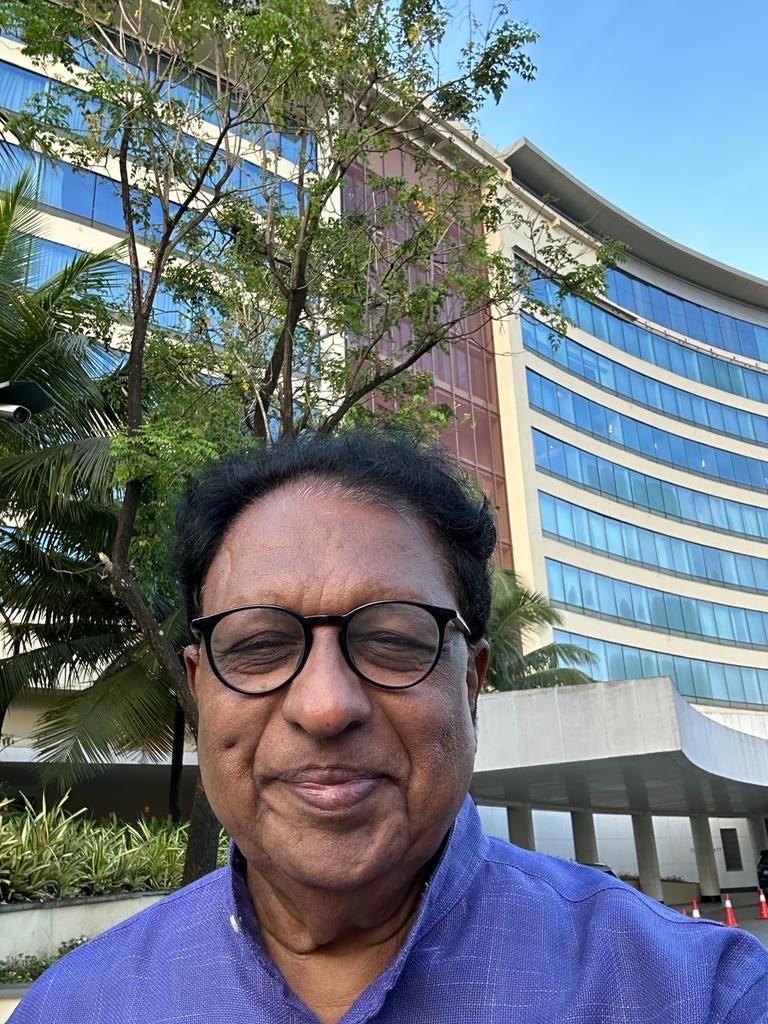
(Photo: TP Sreenivasan, UN Headquarters, New York. All photos © Sree Sreenivasan.)
Global Indian Times: you speak Japanese and Russian. Are you good at llanguages?
Sreenivasan: It was not out of choice. In the Foreign Service, you need to learn one language. It’s called compulsive and is allotted to you. When I joined, Japan was a prominent country, being a leading manufacturing hub. I stated Japanese as my first preference.
The disadvantage of Japanese is that it is a one-country language. If you learn French or Spanish or Russian, you can use it in several countries. Though I was not posted back to Japan, I was sent there several times to interpret for Prime Ministers and other Indian officials.
Global Indian Times: The Tokyo home of the Indian Ambassador must be a very special place.
Sreenivasan: Yes. It is a vast area, an old house, in a very prestigious location in Tokyo. After the Second World War, most of the war reparations India got from Japan were land and buildings. Although the buildings were old, the land was worth an immense amount. Sometimes I say that funds from the sale of properties owned in Japan, would have cleared all of India’s foreign debt. But we didn’t do such short-sighted things. We have very good accommodation for the Ambassador and Deputy Chief of Mission.
Global Indian Times: Are you disappointed you didn’t get posted as Ambassador to Japan?
Sreenivasan: Yes. But I had moved into multilateral diplomacy, where I was considered an expert. So, while I got several postings around the world, I was not considered for Japan
Global Indian Times: Who were your mentors? What did you learn from them?
Sreenivasan: University College was perhaps the best source for English studies, certainly starting from Hridayakumari to Santhakumari. They’re all part of my life. I spent five years as their student. They were inspiring and very encouraging.
Dr. Ayyappa Paniker, whom we thought did not know much English because of the way he spoke—very briefly with intervals to make us understand. Now I realize we did not understand him at all. He was probably the most scholarly, most creative, most outstanding modern poet in Malayalam.
Global Indian Times: Mentors in the service?
Sreenivasan: my first boss was Ambassador Haidar, who was the number two in Tokyo. It was part of his job to train the new officers. Next in Bhutan, my boss was Ambassador Gonsalves, a very decent, capable, charming. Also, very influential in the service.
Ambassador I.K. Gujral, in Moscow, gave me important administrative and political work. He also helped arrange school admissions for my children because he had so much influence in Delhi. While a Head of Mission myself, I got support in Delhi from K.P.S. Menon. One time, I was on my way to Oman. Ambassador Venkateswaran said, “Why are you going to Oman? There’s nothing to do there.” So, he sent me to Fiji, and that became prophetic. I stood up for the local Indian community on the island, under Prime Minister Rajiv Gandhi’s guidance. I was expelled from Fiji.
Global Indian Times: what is your advice as a mentor?
Sreenivasan: First, master English, spoken and written. Then read newspapers. Till I went to college, I read all the pages of The Hindu newspaper. At my father’s direction. That was really the education I got. In my village, the paper was delivered in the evening.
Global Indian Times: how did you adjust to strange, foreign situations every three years?
Sreenivasan: It is a physical, mental, financial challenge. Also, highly stressful. The casualty rate in the Foreign Service is next only to that in the armed forces. You forget yourself. The temptations are too many and difficult to resist. And alcohol is a big issue. You’re paid to drink, serve it, and gift it.
Global Indian Times: You took over and finished wife Chandralekha’s book.
Sreenivasan: It is her memoirs. While we worked together on it, it is her work. She spent the last two years of her life on the book but could not complete it. Soon after her passing, I finished the book. As per her wish, it was released by Kerala’s Governor.
Chandralekha’s book is part of a new genre. Wives of Foreign Service officers are writing about their own career. They play a significant role in a diplomat’s life, which many people don’t know. That is why my wife called it The Better Half of Diplomacy. I agree. Spouses face far more challenges without any training.